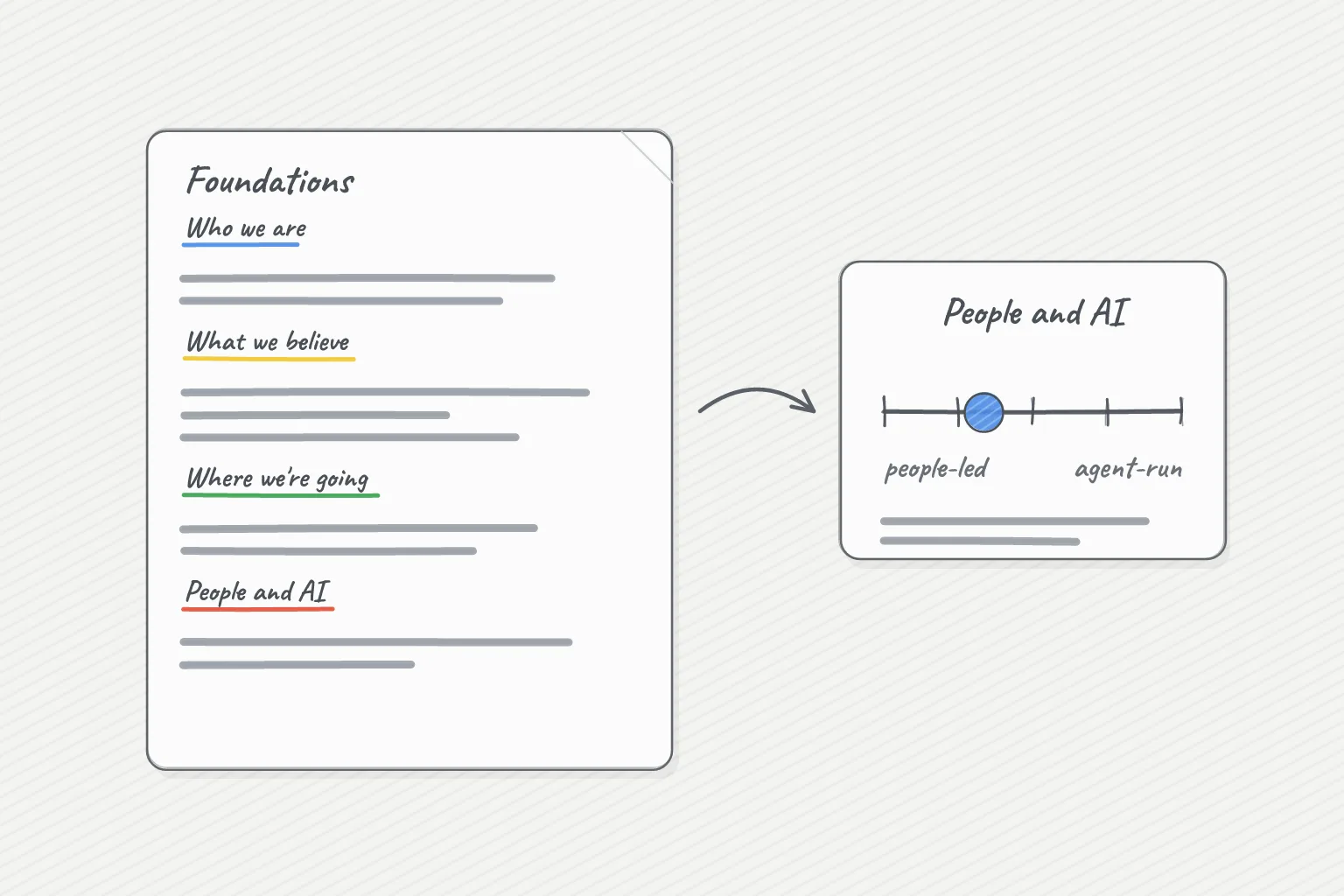
A founder who opens a fresh chat and asks for an AI-native strategy gets a strategy that could belong to any company. The assistant doesn't know what you believe, what you would never do or which work you want to keep with people. Agents built on that strategy inherit the same gap.
The foundations skill is the first step of the founder pack. In one conversation with your own AI assistant it writes a short document, Foundations.md, in your words. The strategy, the operating system, the roadmap and every agent after it read that document first.
Get the foundations skill. It is free and works in Claude, ChatGPT, Gemini and Copilot.
Read a case study: How I wrote an AI strategy that starts with people, by Hugo, one of the founders of Tooling Studio.
What the document covers
| Part | What it says |
|---|---|
| Who you are | What you do, for whom, and why the company exists |
| What you believe | The values your people live by, and what you would never do, even if it paid |
| Where you are going | The company in five to ten years, and your own role by then |
| People and AI | Which work stays with people, what you would hand to agents, and what you owe your team |
| Hard facts and open questions | The numbers, and the doubts you haven't settled yet |
The people and AI part places your company on a scale from people-led to agent-run, per part of the company if you like. The skill never pushes you toward more AI than you want. Many companies need people in the field and customers who want to talk to a person.
An example
From the foundations of a 60-person SEO and content agency in New York:
| Part of the company | Position | In their words |
|---|---|---|
| Client relationships | People-led | "Clients pay for someone who knows their business and tells them the truth." |
| Content | Side by side | "AI does the research and the first outline. A writer who knows the subject writes it, an editor signs it." |
| Reporting | Agent-heavy | "Nobody joined us to copy numbers into slides." |
Read the full example.
Run it in three steps
1. Make a project for your company
Create a project in Claude or ChatGPT, or a Gem in Gemini, and add the skill to your assistant. Every later step runs in the same project, so it finds this document. The guide to adding a skill has the steps.
2. Start the conversation
Say "Start my AI-native plan", with your company's name and website, your role, anything you have written already, and whether you want it quick or a real conversation. The skill reads your website and your attachments before it asks anything.
3. Correct the document
Give it your honest doubts as well as your ambitions. At the end it shows you the document to correct and offers three to five questions you can send your team, so it isn't only your view.
Why this matters for agents
An agent follows its written rules, and those rules come from your design. When the foundations say client relationships stay with people, the operating system keeps agents to preparation and drafts in that work, and each agent's page in the Brain says what it never does. The line you draw here ends up in every agent's instructions.
Foundations questions
How long does it take?
From a few minutes, if you have things written down, to as long as you want to spend thinking it through.
Is it about my company or about me?
Your company. For a plan for yourself, use the mentor.
Who sees my answers?
Only you. Your documents stay in your project, and nothing is sent to Tooling Studio.
What comes next?
The strategy, which reads these foundations.
Next step
Keep this workflow close to Gmail instead of pushing it into another stack
Tooling Studio is built for teams that already work in Google Workspace and want a lighter execution layer without another bloated platform rollout.