
How I wrote an AI strategy that starts with people
My managing partner turned my AI-native draft into a people-first strategy. Two free skills came out of it.
At the end of October I opened a chat with Claude and wrote down why I did not believe an AI-native consultancy could work. Claude never sounded like me on my Substack, my attempt to let it set up our CRM had become messy, and when I am in Jakarta people reply to my WhatsApps because they know me, which an agent cannot copy. I ended with: "I'm happy to be convinced that there is a way, because if there is, then I will absolutely try it."
The company was Ekipa, which I started in 2016 to coach teams in large enterprises in Southeast Asia. At its biggest we had 30 people, many different tools and quite a few people supporting non-billable work. Today it is two partners, a few freelance coaches and me, and I am using it as my test case: if I started this company today, what would I do?
Claude agreed with most of my doubts. Nobody can really automate their own voice, and an agent messaging people in my name would damage trust. Then it asked how many of my hours go to things other than the parts only I can do, which for a consultancy means proposals, preparation, follow-up notes, research and CRM upkeep. It placed us at L1 on Ann Miura-Ko's six-step ladder, which ExO 3.0 borrows from her, and from there we wrote the strategy together.
The most useful part came a few days later, when Paul, our managing partner, reviewed it. My draft said "a small team of people does the work only people can do, and agents run the rest". He made it "an AI-enabled, people-first consultancy", added people measures such as how many people we upskill, and wrote rules for Ekipa itself: the people doing the work choose what to hand over to an agent, and the time agents free up goes back into clients, coaching and learning. Reading his version, I saw how far I had gone down the AI rabbit hole in two weeks.
That changed how I want to help other founders with this. Before an AI-native strategy, a founder has to answer a few questions first: what the role of people in the company is, how far to go in automating the work people do now, and when to hire rather than automate. My own Claude already knew my answers, because I have used it as a peer for strategy and planning for nine months. A founder who opens a fresh chat has none of that, and the strategy they get back will be generic.
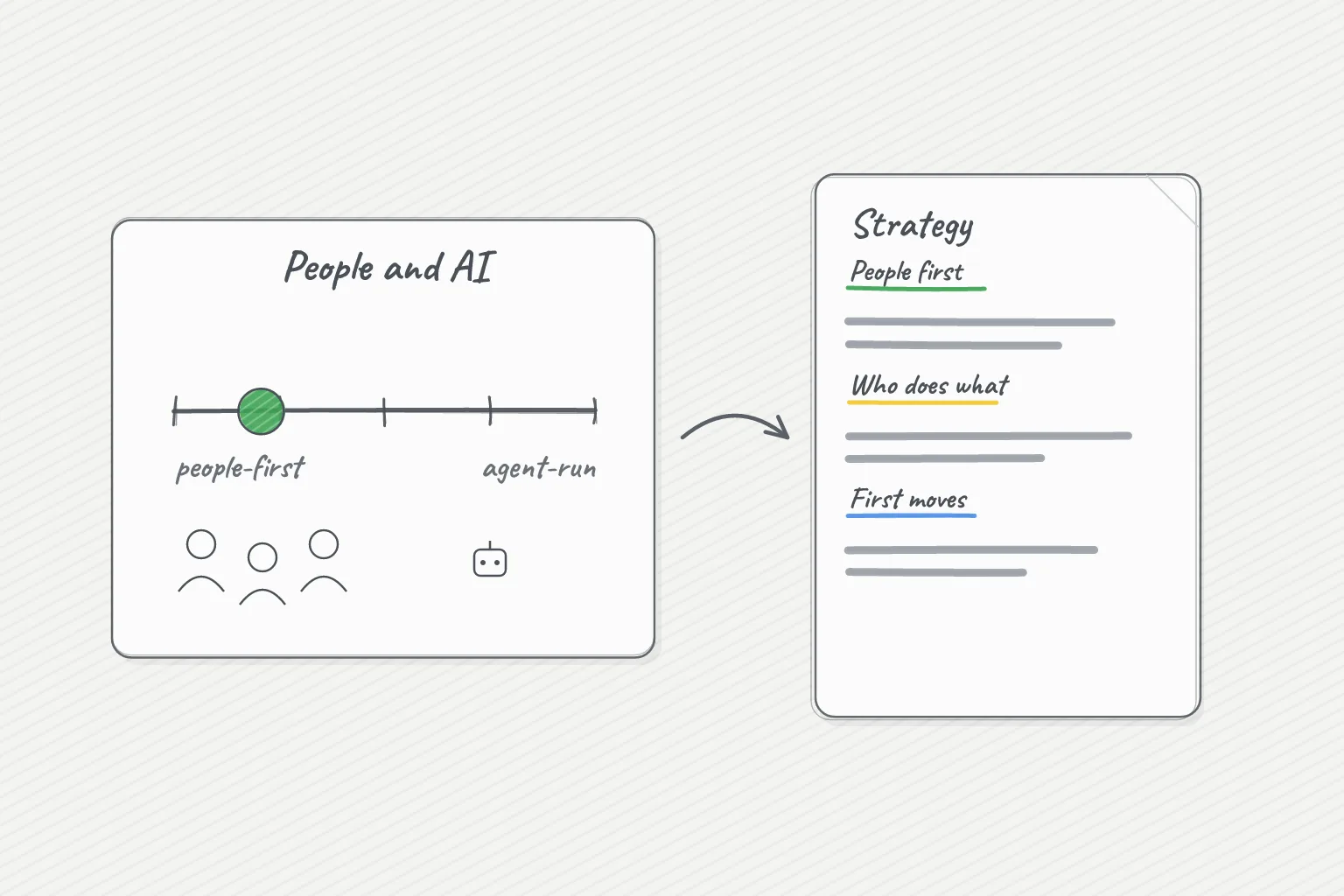
So I split the work into skills, each one a single step that writes a single document. Foundations is a conversation about what you believe, where your company is going and how you want people and AI to work together, and it places you on a scale from people-led to agent-run. Strategy works like a strategy consultant who has done the homework: it reads your foundations and looks at your market before it asks you anything, and it checks the plan against the hours you really have, because in a small company the founder's attention is usually the bottleneck (it told me the same about Ekipa). Because it starts from your foundations, it will not push you toward more agents than you want.
The next step turns the strategy into an operating system. For Ekipa that lives in Tooling Studio, which I have invested in for the past two years. At first it felt close to a gadget, a Kanban board that could replace Trello inside Google Workspace, and it is now becoming the brain and operating system for Ekipa.
I still think tools are never the solution to anything, but if it is an operating system with intelligence, the whole story can become different.
Both skills are free and work in Claude, ChatGPT, Gemini and Copilot. Start with the foundations skill, then make your strategy. The full essay, with everything Paul changed and how I run the skills, is on my Substack: Why my AI strategy starts with people. If you want to talk yours through first, book 20 minutes with me.
 Download our Plugin