
How I wrote down how my company runs, for my people and my agents
In Ekipa's self-management days, SOPs were a dirty word. Now part of the work moves to agents, and an agent only knows what I write down for it.
When Ekipa was 30 people, the answers to how we worked were spread over a document with our principles for self-management, the heads of my people, documents floating around Google Drive, Trello for projects and the CRM, a time tracking tool and lots of Google Sheets. People had the freedom to work as they saw fit, make financial decisions themselves and pick their own tools. SOPs were a dirty word, and the experiment often led to chaos.
Ekipa is the coaching company in Southeast Asia that Paul is now restarting, and I use it as my test case for one question: if I started this company today, with AI, what would I do? The strategy came first. The operating system is the step that turns it into something a team can work from.
Part of the work is moving to agents, and an agent only knows what I write down for it. So the way the company runs has to be written out in plain words, in one place that people and agents both read. That gives Ekipa more structure than it had in the self-management years, and I am fine with that.
What went into Ekipa's operating system
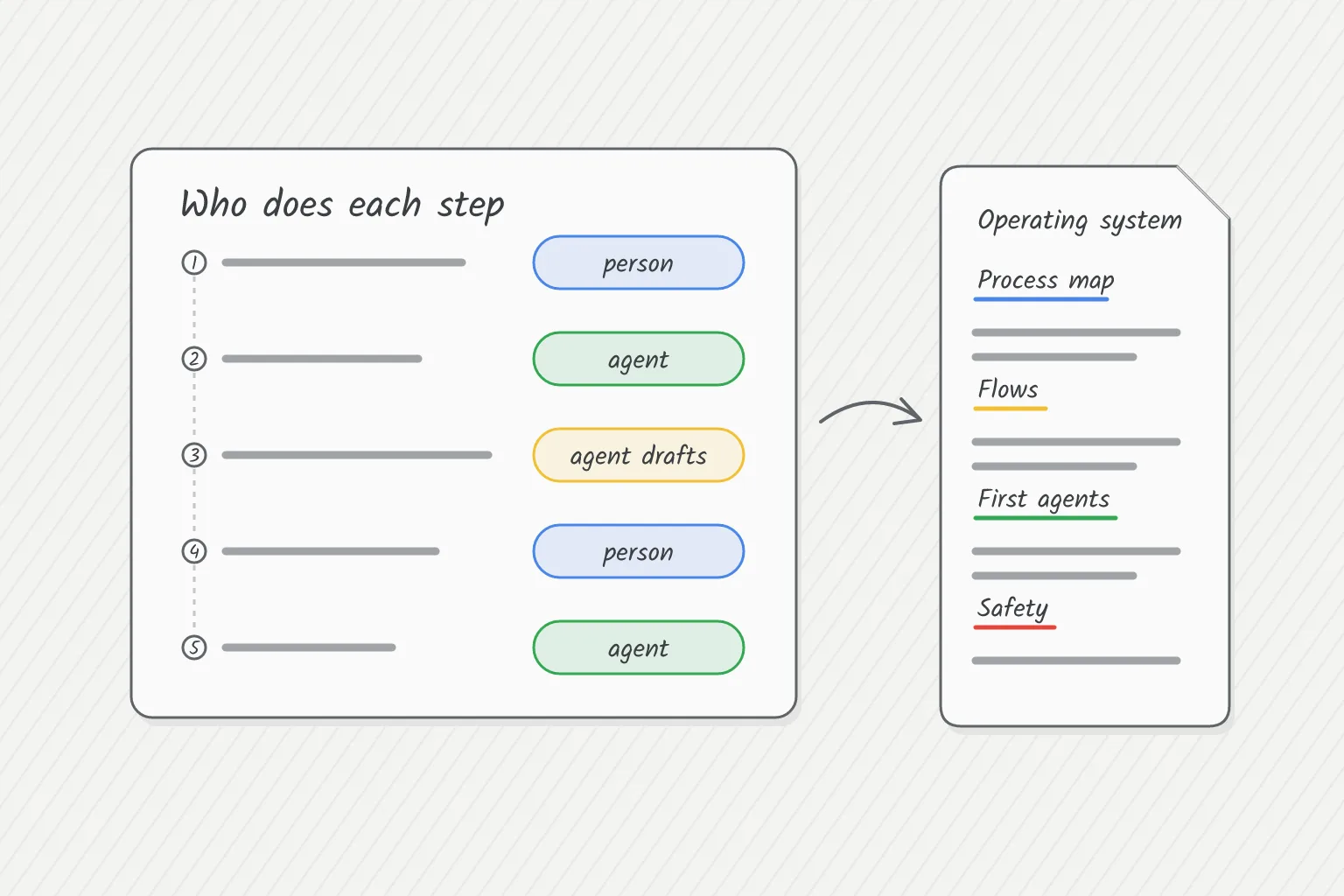
An operating system answers a few questions: which work the company does and how it flows, which roles change, which parts get automated, and whether the tools we use support the new design. For Ekipa it came down to six parts.
- The boards. Five boards in Tooling Studio: client work, the internal build of the operating system, bets on new products, a Friday overview, and one card per agent. They are the overview of everything people and agents do, and Claude now does most of the upkeep that used to be manual.
- The card rules. People and agents work on the same cards, so they follow the same rules: an owner, a due date and a "Done when". One agent, the card checker, comments and tags the person when a card misses one of them.
- People and agents per process. For each of Ekipa's eight core processes, from winning work to running the firm, it says what agents do and what people keep. The line is the same everywhere: agents prepare, run the routine and keep things up to date, and people own relationships, judgment and anything a client or regulator relies on.
- The agents. Every agent we plan is in one table, with what it may do alone, when it asks a person and who owns it. No new kind of agent goes live without four safety basics: a quality check, a log, a way to undo and a review queue with a named person.
- The order of the work. That lives in the roadmap, not here. At first I had the waves in both documents, and I would have been keeping two versions of one plan in sync.
- The tools and the rhythm. Tooling Studio holds the work and the agent rules, Claude runs the agents, and Google Workspace holds our documents, inbox and calendars. Cards get picked on Monday, the overview comes on Friday, the operating system gets a monthly review and the strategy a quarterly one.
What I learned
1. Strategy to a working system in a few days
I used to spend weeks on strategy, workshops with the team, and then OKRs and tasks. This time I went from strategy to operating system to roadmap, and put all of it in Tooling Studio, in less than three days. Ekipa is being revived and is not a big running team, so I would be curious to see this in a larger company where people are busy with the day-to-day. Still, I think a leader who takes the time to use these skills well can do it without hiring expensive consultants.
2. I can work on several levels at once
While I describe the boards I start thinking about how a card title should look, or how people and agents should write notes in the CRM. Normally I would park that thought and forget it. This time I left a comment in the draft and asked Claude for rules to keep a good overview in Kanban, tested on a real board first. It wrote them into the operating system in minutes. The safety rules, the writing rules for agents and the folder rules for our shared drive started the same way.
3. Rules for a small team are now worth writing
Writing rules for how to use Trello used to be too much work for a small team. Claude writes them in two minutes, follows them, and checks whether I followed them myself.
The operating system is step 3 of the founder pack, a free skill for Claude, ChatGPT, Gemini and Copilot. It reads your foundations and strategy and, if you connect them, your email, drive and calendar, so the map starts from how work really moves through your company. The full post, with screenshots of Ekipa's documents and boards, is on my Substack: From strategy to operating system in 2 days. If you want to talk yours through first, book 20 minutes with me.
 Download our Plugin