
Nineteen agents on a board, and the two we build first
Ekipa's operating system names nineteen agents. We build them one at a time, with the person who knows the work, starting with the agent that finds people to meet and the one that checks it.
When I am in Jakarta and want to book meetings, people reply to my WhatsApps because they know me. An agent cannot copy that, and it was one of the reasons I doubted a consultancy like Ekipa could be AI-native at all. What an agent can copy is the work before the message: going through my list, checking when I last spoke to someone, seeing where they work now and finding a reason to meet.
That became the first agent we build for Ekipa, the coaching company in Southeast Asia that Paul is restarting and that I use as my test case. It is one of nineteen.
Nineteen cards, one per agent
Ekipa's operating system has a table with every agent we want, each with its job, its limits and the person who owns it. In Tooling Studio that table became a board called Ekipa Agents, with one card per agent and three lists: Planned, Building and Paused. Each card says which wave of the roadmap the agent belongs to, from wave 0 to wave 4.
The cards range from small to large. The card checker looks every day whether each card has an owner and a due date. Cockpit writes the Friday overview from all boards and drafts the weekly OKR check-ins. Drive upkeep moves files into the right folders of our shared drive. Further out, in wave 4, are bookkeeping and the tax filings for Indonesia, Singapore and Malaysia. Two are paused: a podcast, and a regulatory library where a named person has to check every update.
Nineteen agents is a list, not a plan you can build at once. So we outline all of them, build one properly, and then roll out the rest one by one.
The two we build first
The first two belong together.
The Hunter spots who each partner should talk to next and why, from our own network and through introducers. It adds the new people and companies to the prospecting board in our CRM, and every Monday it sends each partner an email with up to ten people and pointers for the message. The partner writes and sends every message. The Hunter is done when it has run for two weeks and its suggestions turn into real conversations.
CRM upkeep keeps contacts, companies and deals current from email, calendar and our meeting notes. It checks the Hunter's new leads for duplicates, missing fields, an owner and a stage. It also checks us: suggestions nobody answered, meetings without notes. Until the handover it asks its questions to me, and a person confirms every stage change.
Neither is finished. Both sit in the Building list, next to an agent that reads LinkedIn signals for the Hunter and two that prepare our events and community.
How an agent gets built
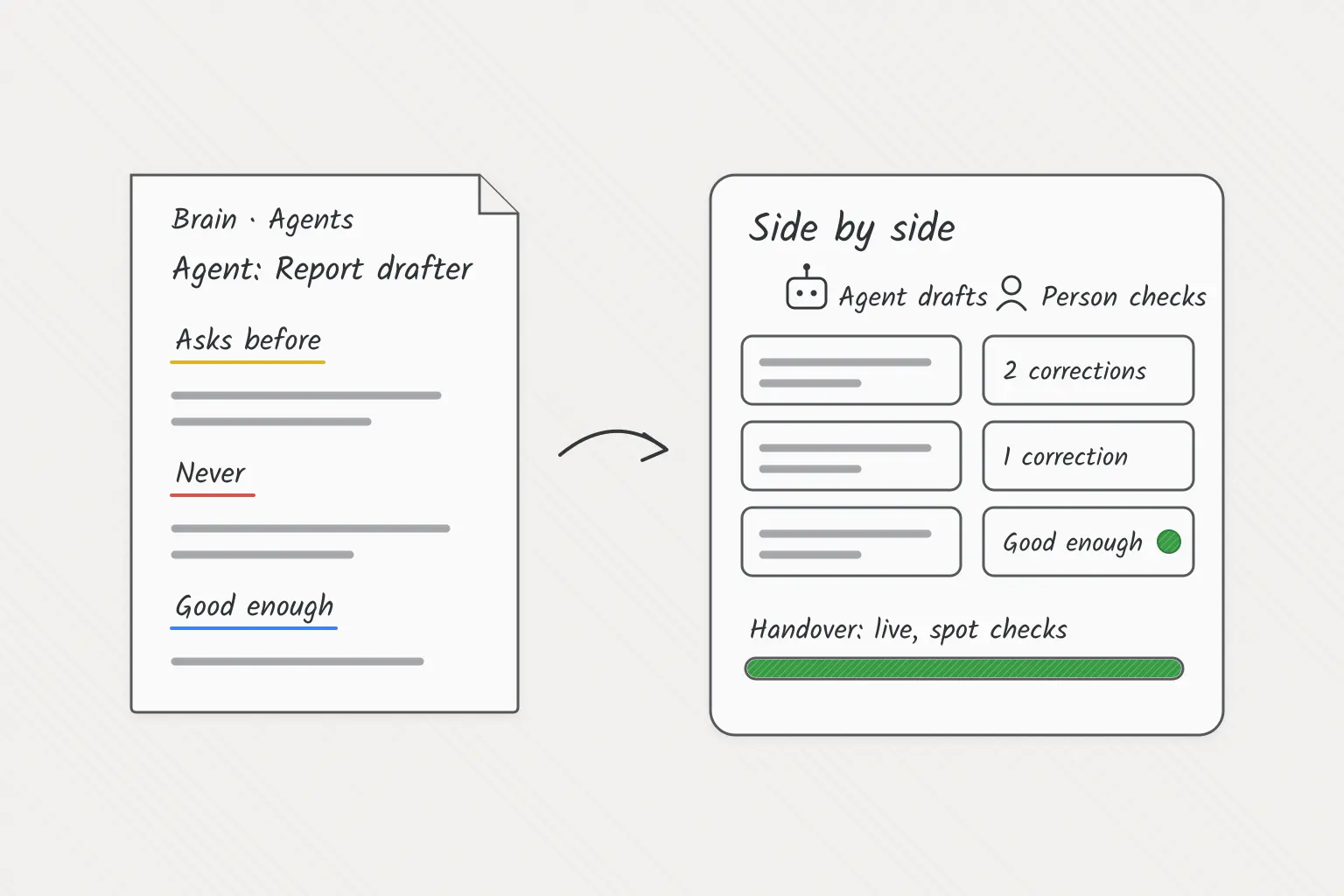
I wrote the method down as the agent builder, step 6 of the founder pack. It works from the agent's line in the operating system and goes through six steps with the person who knows the work:
- How the work is done today, from two or three recent cases. The exceptions become the moments the agent stops and asks.
- The data it reads and writes, checked by reading from our tools.
- The rules, on one page in the Brain, with what "good enough" means agreed before anything runs.
- A small skill that runs the agent and reads that page every time, so a change to the page changes the agent on its next run.
- A test on past cases, then a run next to the person who does the work today, who checks every output.
- The handover, when the owner says it is good enough, and checks drop to spot checks.
What I learned
1. Each agent needs a person who owns it
Every agent in the table has a person who owns it. That person explains the work, decides when the agent is good enough and reviews it afterwards. An agent without an owner doesn't get built.
2. One page for the rules, read by people and agents
An agent's rules easily end up in three places, its prompt, its spec and its card, and those copies drift apart. So each agent gets one page in the Brain. Its owner edits it, the team can read what the agent is told to do, and the agent reads it before every run.
3. The agent prepares, the person keeps the relationship
The Hunter does the work before a meeting: the list, the last conversation, where someone works now and a reason to meet. The message, the relationship and the meeting stay with the partners, which is the line Ekipa's operating system draws for every process.
The agent builder is step 6 of the founder pack, a free skill for Claude. It outlines every agent from your operating system in the Brain, then builds them one at a time with their owners, and checks each one once it runs. The steps before it are on the skills page. If you want to talk your agents through first, book 20 minutes with me.
 Download our Plugin