
How I built an AI mentor that knows my board
Four authors I admire, two hours of answers, and a board it can read.
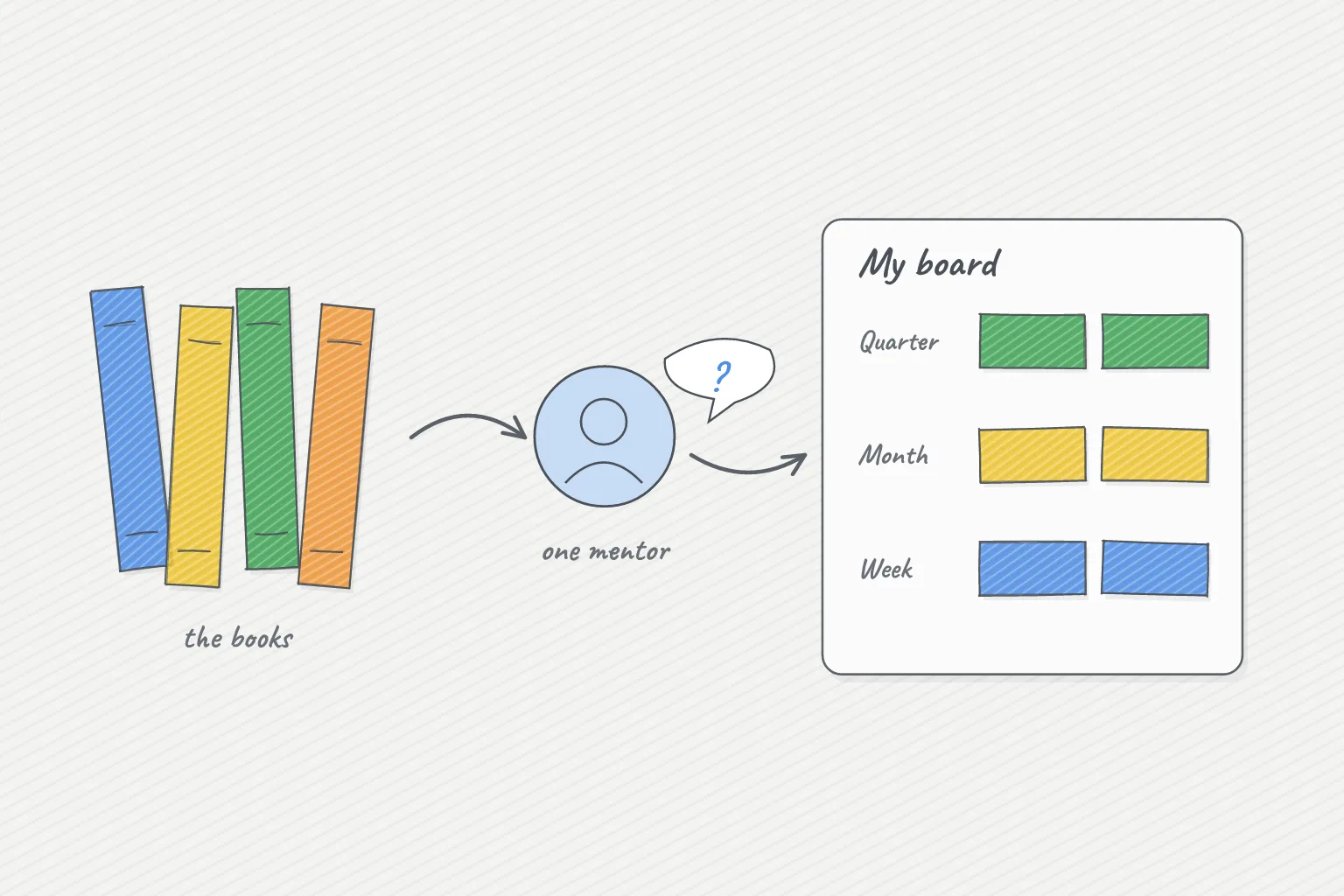
For twenty-five years I have been looking for a mentor. The ones I found were generous, smart and busy, and I was lucky to get two calls a year with them. I read every Sivers, Ferriss, Naval and Michael Singer book, trying to substitute the books for the men, but a book is a mentor's pre-recorded monologue and it does not answer back when you ask it about the decision in front of you.
Sivers can tell me in a book that it should be hell-yeah or no. He cannot tell me whether the meeting I am taking on Thursday passes that test, or whether the proposal I am drafting belongs in this year or the next. That gap is why we keep looking for mentors, and it is the gap I wanted Claude to close.
I built the mentor as a blend of the people I had collected in books: Verne Harnish on strategy, Tim Ferriss on experimentation, Naval Ravikant on long-term thinking and Michael Singer on the inner work (thanks to Ruben Hassid for the playbook). Each one does something the others do not, so the mentor pushes back on me in more than one direction.
Most of the work went into defining myself well enough that the mentor had something to mirror back. I spent weeks in my office in Bali writing down what defined me, and then let Claude interview me, answering by voice, about where I want to be in ten years, my values, the plans from an earlier version of me that I had not let go of, and what I will not do this year.
Once that was written, the risk was that the mentor would become another tab I open and close. So I connected it to the place where my work lives. I run my work in Tooling Studio (I am a co-founder, so I am biased), with a team per venture and a personal board that holds my goals for the quarter, the month, the week and the day. Through the MCP connection the mentor reads that board without me copying anything into the chat.
On Monday I ask it one question: looking at my plan and at this week, is this an impactful week, or am I avoiding something I should be doing instead? Nobody else in my life can answer that, because nobody else has both pieces of context at the same time. When I get stuck mid-week, I ask it to call the circle I am in by name and tell me to stop. Sometimes it says something more interesting, like the morning it told me that my work that day was "the philosopher's work, not the operator's" and ended an hour of circling.
It is not the same as having a seasoned entrepreneur across the table, and I still look for people who can mentor me on specific topics. But a lot of what a good mentor does is feed back what you already half-know and ask the question you are avoiding, and that part is now there at any hour. Of all the things people are excited about with AI, this is the one I would not give back.
In May I did this by hand, with two long prompts and about two hours of answers. I have since put the setup into one skill: it asks which mentors you want, asks five questions about your plan and grows the plan from there. Get the mentor skill. If your goals and tasks live in Tooling Studio, it can read them and create the week's tasks for you.
The original essays are on my Substack: The mentor I built and How to hire the world's best mentor.
 Download our Plugin