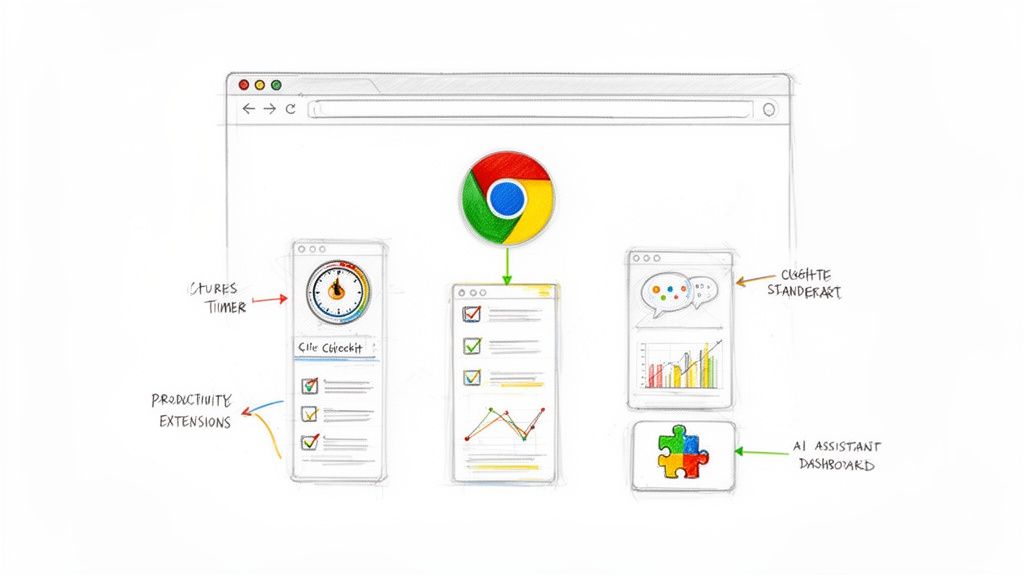
Best chrome extensions productivity guide: compare 12 picks by use case, with quick recommendations for Gmail, writing, tabs, time tracking, and focus.

Updated on 04/29/2026: Sales CRM is no longer in beta. It has been officially released. View Sales CRM.
Not every productivity extension deserves a permanent place in Chrome. Some save real time inside work you already do; others just add another capture layer, another sidebar, or another set of permissions to manage.
This guide ranks 12 picks by the bottleneck they solve best: Gmail-driven task management, quick task capture, writing, reusable replies, tab overload, research saving, time tracking, documentation, async communication, and focus. In our review, the strongest tools were the ones that removed a step from work already happening in the browser rather than asking you to build a new system around the extension.
If most of your day runs through Gmail and Google Workspace, start with Tooling Studio. Browser-based work is now the norm for many teams, and knowledge workers using Google Workspace spend large parts of the day in email, collaboration, and task management according to Todoist's roundup of Chrome extension research. That is why Tooling Studio stands out here: it keeps tasks, boards, and follow-up workflows close to where work arrives.
| If you need to... | Start with | Best for |
|---|---|---|
| Turn Gmail into a task and project workspace | Tooling Studio | Google Workspace users, teams, agencies, sales and service work |
| Capture tasks from any webpage | Todoist for Chrome | Personal task capture and daily planning |
| Write clearer emails and documents | Grammarly | Writing, editing, tone, and grammar support |
| Stop typing the same replies | Text Blaze | Support, sales, recruiting, admin, and operations teams |
| Clear tab overload fast | OneTab | Quick tab cleanup and browser memory relief |
| Organize tabs by project | Workona | Researchers, marketers, operators, and multi-project work |
| Save research into Notion | Notion Web Clipper | Notion users who collect articles, references, and ideas |
| Save quick notes in Google | Google Keep | Lightweight notes, links, quotes, labels, and reminders |
| Track where work time goes | Clockify Time Tracker | Freelancers, agencies, consultants, and project teams |
| Replace status meetings with video | Loom | Async updates, walkthroughs, reviews, and handoffs |
| Document repeatable workflows | Scribe | Onboarding, support, operations, and internal process docs |
| Block distracting websites | StayFocusd | Focus sessions and reducing time-wasting sites |
A productivity extension only helps if it removes friction from the work you already do. A tool that opens another dashboard, creates another inbox, or requires a big process change can become one more thing to maintain.
So the picks below are judged on four practical questions:
We expanded those criteria with day-to-day checks that matter more than feature lists. Setup friction matters: an extension that takes two minutes to understand will usually outperform one that needs an hour of configuration, especially for solo users and small teams. We also weighed permissions sensitivity, because browser tools can touch email, tabs, page content, and account data. Before a tool earns a recommendation, it needs a clear justification for the access it requests.
Reliability mattered as much as raw capability. Chrome has a huge extension ecosystem — more than 111,000 distinct extensions were listed in the store by 2024 according to DebugBear's Chrome extension statistics — which makes update cadence, review quality, and practical maintenance more important than marketing copy. In a crowded category, we favor picks with a focused job over bloated all-in-one promises.
Consider whether the free version is usable. Many browser extensions look appealing until the first useful action is locked behind a paywall. The strongest picks gave users a real workflow improvement before asking for an upgrade. That matters because the best browser extensions boost productivity by shaving time off routines you already repeat, not by demanding a paid migration before the value is visible.
Finally, we ranked tools by workflow fit, not by popularity alone. Broad market usage trends are still useful context: a 2024 review of major-market extension behavior found that high-adoption productivity add-ons cluster around blockers, task tools, and writing assistants, as summarized in Venture Harbour's productivity extension roundup. But a widely installed tool is not automatically the right pick for your browser. We would rather recommend the extension that cleanly removes one recurring step than the one that claims to do six jobs poorly.
For Google Workspace teams, a good productivity stack is usually small. The goal is to remove steps from the work you already do in Gmail, Calendar, Drive, Docs, and Chrome, not to collect extensions with overlapping jobs.
A practical setup usually has three parts:
Add Clockify when time needs to become a client report or billing record. Add StayFocusd when distraction is the bottleneck. Be careful with multiple task managers in the same browser; the extra capture points can create duplicate work instead of reducing it.
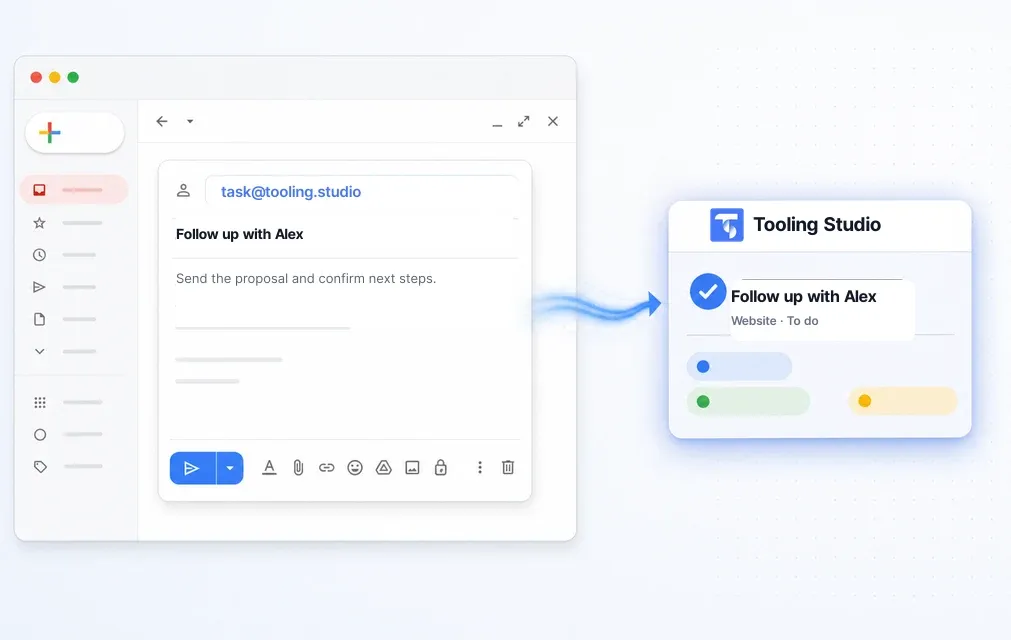
Most productivity tools ask you to move work somewhere else. Tooling Studio is different: it puts task boards and CRM workflows inside Gmail and Google Workspace.
That matters because a lot of real work still starts in email. A client sends a request. A teammate forwards a follow-up. A lead replies with next steps. Without a system, those messages turn into flags, unread emails, sticky notes, or separate project-management tabs that people forget to update.
Tooling Studio turns that mess into a visual workflow. You can create tasks from Gmail, manage work on Kanban boards, assign teammates, add due dates, use comments and attachments, and keep shared boards updated in real time. If your team also manages leads and customers in Google Contacts, Tooling Studio's Sales CRM adds lightweight pipelines, notes, tags, contacts, organizations, and deals in the same Google-native environment.
What pushed Tooling Studio to the top is workflow fit. It beats general task-capture tools when the work originates in Gmail, because it cuts out the usual handoff from email to separate project software. In our review, that made adoption easier for small teams: people understand "turn this email into a task" faster than they understand a full PM rollout. The tradeoff is clear too: if you need advanced portfolio planning or deep engineering workflows, this is not trying to replace a heavyweight platform.
Tooling Studio is a strong fit for founders, agencies, consultants, sales teams, support teams, operations teams, and small businesses that live in Google Workspace but do not want a heavyweight work OS.
Use it when you want to:
Skip Tooling Studio if your team needs advanced enterprise portfolio planning, deep developer issue tracking, or a mobile-first workflow today. It is built to be lightweight, Google-native, and easy to adopt.
Try it: Install Kanban Tasks from the Chrome Web Store or see how Kanban Tasks works.
Todoist is one of the most useful Chrome extensions when you need a fast way to capture tasks while browsing. You can add a webpage as a task, save selected text, plan your day, and check off work without opening a full task manager.
It works especially well for people who already use Todoist across desktop, mobile, and calendar workflows. If your productivity problem is personal task capture rather than team work inside Gmail, Todoist is a clean choice.
Todoist ranks just below Tooling Studio because it is better at individual capture than shared workflow coordination. That is not a flaw; it is the category difference. If your day is full of tabs, articles, and personal follow-ups, Todoist is easier to adopt than a team board. If your tasks mainly come from active email threads and shared ownership, it loses some of its speed advantage.
Todoist is less direct if your work starts in shared inboxes, client emails, or Google Workspace team workflows. In that case, Tooling Studio is a better fit because it keeps the task board closer to Gmail.
Website: Todoist for Chrome
Grammarly helps improve writing across the browser. It checks grammar, spelling, punctuation, clarity, tone, and style while you write in tools like Gmail, Google Docs, LinkedIn, and other web apps.
The productivity win is simple: fewer rewrites, fewer awkward messages, and less time second-guessing how something sounds. For people who write customer emails, proposals, support replies, hiring messages, or public posts, that adds up quickly.
Grammarly places this high because writing quality affects almost every browser workflow, and the adoption curve is close to zero: install it and the value shows up where you already type. It beat adjacent writing tools here because it works broadly across web apps instead of locking the improvement to one editor. The tradeoff is that it improves phrasing, not process. If you need shared approved language, pair it with a snippet tool. For a quick overview of its positioning and feature set, Flaex.ai's guide is a useful companion resource.
If your team needs approved shared messaging, snippets, or repeatable templates, pair Grammarly with Text Blaze instead of relying on free-form writing every time.
Website: Grammarly for Chrome
Text Blaze is a strong productivity extension for anyone who types the same thing more than twice. It lets you create snippets and templates, then insert them with shortcuts anywhere you write in Chrome.
Meaningful value appears in repetitive business workflows: support responses, sales follow-ups, recruiting outreach, appointment instructions, onboarding notes, status updates, and internal handoff messages.
Text Blaze outranks most other typing tools because the time savings are immediate and measurable. We would choose it over a generic AI writer when the problem is repetition rather than composition. It also complements Grammarly well: Grammarly improves the message you are writing; Text Blaze helps you stop rewriting the same message from scratch. The tradeoff is that snippet libraries need light maintenance or they become stale.
Text Blaze does not manage the work after the message is sent. If a reply creates a task, customer follow-up, or project step, connect that work to a task system like Tooling Studio or Todoist.
Website: Text Blaze
OneTab solves a specific problem well: too many open tabs. Click the extension and your open tabs collapse into a list you can restore later.
That makes it useful when your browser has become a cluttered mix of research, half-finished work, admin pages, documents, and distractions. Instead of losing everything or keeping 50 tabs open, you can park them and return when needed.
OneTab earned the fifth spot because it delivers one of the fastest visible wins on this list. In our review, OneTab was the fastest fix for immediate tab overload, while Workona made more sense for ongoing project context. That distinction matters: OneTab is for cleanup now, not organization later. If you just need breathing room before getting back to work, it beats more elaborate tab systems on speed alone.
OneTab is for quick cleanup, not long-term project organization. If you want tabs grouped by client, project, or workflow, Workona is a better fit.
Website: OneTab
Workona is for people whose browser is their workspace. Instead of treating tabs as one long row, it organizes them into spaces by project, client, topic, or workflow.
This is especially useful when you work across multiple cloud apps. A marketing campaign might need Analytics, Google Drive, Notion, ad dashboards, design files, and competitor pages. A client project might need email, docs, contracts, tasks, and research. Workona gives those tabs a home.
Workona helps organize browser context, but it does not replace task ownership. Use it alongside a task system when work needs assignees, due dates, and status.
Website: Workona Tab Manager
Notion Web Clipper is a simple extension for saving pages into Notion. If Notion is already your team wiki, research database, or content planning system, the clipper makes it easier to collect articles, references, examples, and ideas while browsing.
The benefit goes beyond saving links: useful material lands in the place where you will later organize it, comment on it, tag it, or turn it into action.
If you only need quick personal notes, Google Keep is lighter. If the saved page creates a follow-up task, make sure it also lands in your task system.
Website: Notion Web Clipper
Google Keep is the best lightweight option for people who want simple note capture without building a full knowledge-management system. The Chrome extension lets you save URLs, text, and images to Keep, add notes, and apply labels.
It is not trying to be Notion, Todoist, or a project manager. That is the point. It is fast, familiar, and already connected to the Google ecosystem.
Google Keep gets messy when notes become projects. If a note needs ownership, due dates, and team visibility, move it into a task board.
Website: Google Keep Chrome Extension
Clockify helps you track work time from Chrome, then review it in reports. It is useful for freelancers, agencies, consultants, and teams that need to understand where time goes across projects.
The extension is practical because it lets you start a timer from the browser instead of opening another app. It also supports reminders, idle detection, a Pomodoro timer, and integrations with many web apps.
Time tracking is only useful if someone reviews the data. If nobody changes behavior, pricing, planning, or scope based on the reports, the extension becomes admin work.
Website: Clockify Time Tracker
Loom is a productivity extension for explaining work without scheduling another meeting. You can record your screen, camera, microphone, and system audio, then share the recording with a link.
It is useful when written instructions would take too long or when context matters: design feedback, product walkthroughs, bug reports, client updates, onboarding, support explanations, and internal status updates.
Do not use video when a checklist, task, or short written decision would be clearer. Loom works best when seeing the screen saves time.
Website: Loom Chrome Extension
Scribe is built for documenting workflows. It can capture a process and turn it into a step-by-step guide with screenshots and text instructions.
That makes it useful for operations, customer support, onboarding, training, and internal process documentation. Instead of manually taking screenshots and writing every step, you can document a repeatable workflow while doing it.
Scribe documents how work is done; it does not decide whether the work should exist. Before documenting a process, remove unnecessary steps first.
Website: Scribe for Chrome
StayFocusd helps you limit time on distracting websites. You choose the sites, set limits, and make it harder to drift into time-wasting loops during work hours.
This type of extension is useful when your biggest productivity problem is not task capture or organization, but attention. It creates a speed bump between intention and distraction.
A blocker will not fix unclear priorities. If you are avoiding work because the next step is vague, clarify the task first, then use StayFocusd to protect the work session.
Website: StayFocusd
The 12 picks above cover the most common productivity needs. A few other extensions are worth a look when your workflow is more specific.
Streak is useful for sales teams that want pipelines and contact activity inside Gmail. It is strongest when the whole sales process already runs through Google Workspace and reps need fewer jumps between email and CRM records.
Choose Streak if you want a dedicated Gmail CRM. Choose Tooling Studio if you want task boards and lightweight CRM workflows in the same Google-native workspace.
ClickUp's extension makes sense when your organization already runs on ClickUp. It can help with task capture, screenshots, annotations, time tracking, and turning browser context into ClickUp work items.
Skip it if ClickUp is not your system of record. In that case, it can become another capture layer instead of a cleaner workflow.
Save to Google Drive is a simple fit when your team keeps source files, assets, PDFs, and references in Drive. It is not a task manager, but it can reduce the small manual work of saving browser files into the right Google account.
Momentum replaces the new tab page with a calmer daily focus view. It is best for people who want a lightweight prompt around the day's main priority, not a full task system.
RescueTime is useful when you need passive time awareness across apps and websites. Forest is better when you want a simple focus ritual. Both can help with attention, but neither solves unclear ownership, missing due dates, or scattered team work.
Choose Tooling Studio first. This is the clearest fit for teams that receive work through email, need shared visibility, and do not want to bounce between inboxes and a separate PM tool. Add Grammarly if message quality matters, or Text Blaze if you send repeat replies.
Start with Todoist for capture, then add OneTab only if tab clutter is a separate problem. This pairing keeps the stack light: one tool for remembering what to do, one tool for clearing visual overload.
Use Grammarly as the primary extension and Text Blaze as the companion. That gives you one tool for improving live writing and one for eliminating repetitive typing. We would avoid installing multiple writing assistants at once because overlap creates noise more often than speed.
Pick Workona if you routinely juggle several clients, campaigns, or cloud apps at the same time. Use OneTab instead if the problem is not project structure but simple tab overload. One is for persistent context; the other is for immediate cleanup.
Use Loom when people need to see what is happening on screen, and use Scribe when the same process should become a reusable standard operating procedure. A good rule: Loom for explanation, Scribe for repeatability.
Install StayFocusd only after your task list is clear. A site blocker is useful when the work is defined and attention is the weak point. If the next step is fuzzy, a blocker just traps you with unclear work.
The right extension depends less on features and more on where your friction lives. Apply this framework before you install anything new.
Pick the problem you feel several times a day, not the one that sounds most impressive.
A two-tool stack often works better than a ten-tool stack.
If two tools solve the same problem, pick the one that fits your existing workflow better and uninstall the other. Extension overload is real: too many icons, too many permissions, and too many overlapping capture points can make Chrome slower and your system messier.
Use a quick pre-install checklist on the Chrome Web Store page:
A good rule of thumb: if an extension does not save you time in the first week, it probably does not deserve a long-term place in your browser.
If you are an individual looking for a cleaner browser, start with one narrow tool: OneTab for tab clutter, Todoist for personal tasks, Grammarly for writing, or StayFocusd for attention.
If you are a Google Workspace user trying to manage real work from Gmail, start with Tooling Studio. It solves the highest-value problem on this list: turning the place where work arrives into the place where work gets organized.
You can use it personally for free, then add team collaboration when shared boards or pipelines become useful.
Tooling Studio is the strongest pick if your work starts in Gmail or Google Workspace. It turns emails into tasks, keeps work on shared Kanban boards, and helps teams manage follow-ups without copying everything into a separate app.
Install the extension that removes your most frequent bottleneck. Use Tooling Studio for Gmail tasks and team boards, Grammarly for writing, OneTab or Workona for tab overload, Loom for async updates, and StayFocusd for distraction control.
They can be, but you should check the Chrome Web Store permissions, update history, publisher, and recent reviews before installing. Keep your stack small so every extension has a clear job and unnecessary browser permissions do not pile up.
For many Google Workspace teams, Tooling Studio can replace a separate lightweight task board or simple sales follow-up workflow because it works directly inside Gmail and Google Workspace. It is not meant to replace heavyweight project management or enterprise CRM systems.
Tooling Studio is free for personal use. Team collaboration is paid at $5 per user per month per product, so you can start individually and only pay when shared boards or sales workflows become useful.
Turn Gmail into the productivity extension your team uses
Install Tooling Studio to turn emails into tasks, organize work on shared Kanban boards, and keep customer follow-ups visible without leaving Google Workspace. Personal use is free.