
What Is Scrum Methodology A Guide to Agile Success
Discover what is scrum methodology through its core principles, roles, and events. Learn how this agile framework boosts team agility and project results.
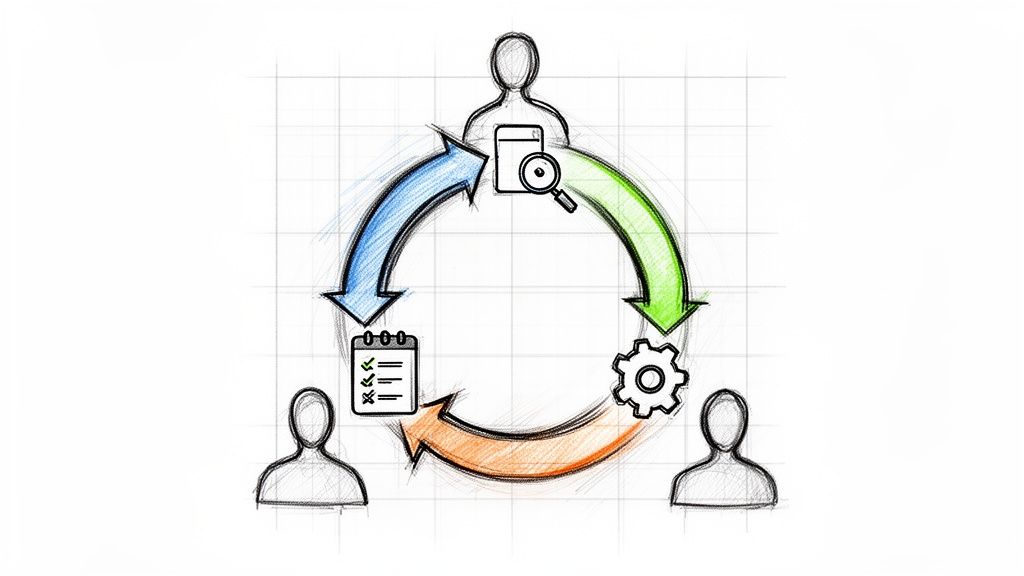
Scrum is an agile framework teams use to ship valuable work to customers through short, iterative cycles. Instead of locking into a rigid, long-term plan, Scrum breaks big projects down into smaller, more manageable pieces. This approach fosters flexibility, tight-knit collaboration, and continuous improvement from start to finish.
Demystifying The Scrum Framework
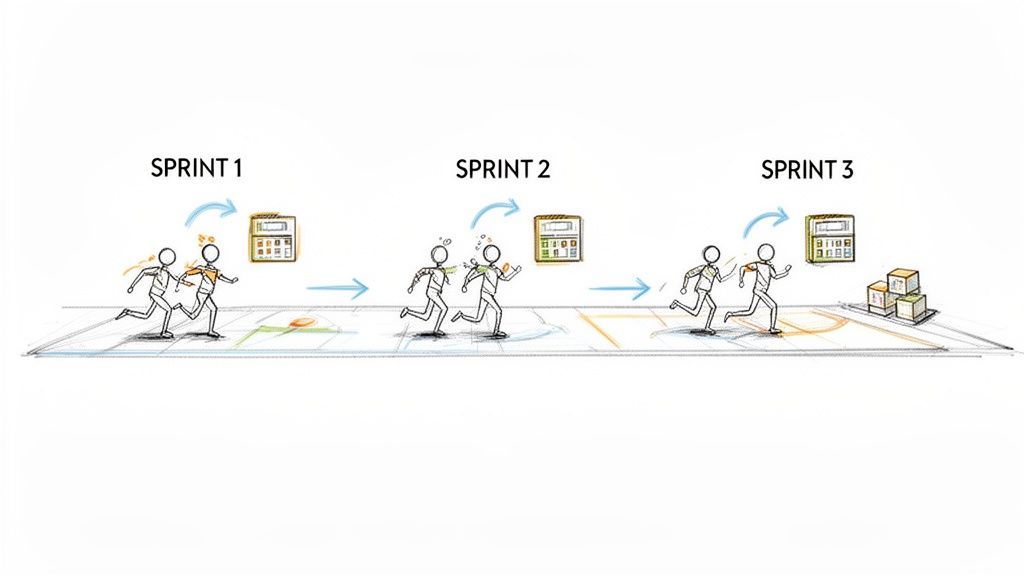
Think of a sports team aiming for a championship. They don't just show up for the final match and hope for the best. They practice specific plays, review their performance after every game, and adapt their strategy constantly. Scrum works in a very similar way. It’s not a strict, step-by-step instruction manual but a flexible framework built on the rhythm of inspection and adaptation.
At its heart, Scrum is all about empirical process control. This is just a fancy way of saying that decisions are based on what you can see and learn through experience, not on detailed upfront plans that rarely survive contact with reality.
This entire approach rests on three core pillars.
The Pillars of Empiricism
- Transparency: Everyone involved needs to have a clear view of what’s happening. The work, the progress, the roadblocks—it all needs to be out in the open to create a shared understanding.
- Inspection: The team frequently pauses to check its progress toward the goal. This isn’t about micromanagement; it’s about spotting problems or unwanted deviations early.
- Adaptation: When an inspection reveals something is off track, the team adjusts its process or the product itself to get back on course and minimize any further issues.
This constant loop of feedback and adjustment happens in short cycles called Sprints. Each Sprint is like a mini-project that delivers a tangible, usable piece of the final product. It’s a structure that lets teams respond to change incredibly fast and deliver value sooner.
And it’s wildly popular for a reason. One report found that a massive 87% of organizations using Agile frameworks lean on Scrum at the team level, making it the go-to choice by a long shot.
By focusing on delivering functional increments in short cycles, Scrum helps teams navigate complexity and uncertainty. It replaces the "big bang" release with a steady rhythm of value delivery, reducing risk and improving stakeholder satisfaction.
To really get a feel for where Scrum fits in the bigger picture, it helps to see how it stacks up against other methods. This breakdown of Agile vs. Waterfall vs. Scrum is a great resource for clarifying why its adaptive nature is so powerful for modern projects.
To give you a clearer picture, here’s a quick rundown of the essential components that make Scrum tick.
Scrum Framework at a Glance
| Component Type | Name | Primary Purpose |
|---|---|---|
| Role | Product Owner | To represent the stakeholders and define the vision for the product. |
| Role | Scrum Master | To guide the team, remove obstacles, and ensure Scrum practices are followed. |
| Role | Development Team | To build the product increment; a self-organizing, cross-functional group. |
| Event | The Sprint | A time-boxed period (usually 1-4 weeks) to create a usable product increment. |
| Event | Sprint Planning | To plan the work to be performed during the upcoming Sprint. |
| Event | Daily Scrum | A short daily meeting for the team to sync up and plan their day. |
| Event | Sprint Review | To inspect the increment and adapt the Product Backlog if needed. |
| Event | Sprint Retrospective | To reflect on the past Sprint and identify ways to improve. |
| Artifact | Product Backlog | An ordered list of everything that might be needed in the product. |
| Artifact | Sprint Backlog | The set of Product Backlog items selected for the Sprint, plus a plan. |
| Artifact | Increment | The sum of all completed Product Backlog items from a Sprint. |
This table neatly summarizes the roles, events, and artifacts that form the backbone of the Scrum framework. Each piece plays a critical part in creating that cycle of transparency, inspection, and adaptation.
Understanding Scrum's Pillars and Values
To really get what makes Scrum tick, you have to look past the meetings and job titles and dig into its core principles. The whole framework is built on what’s called “empirical process control,” which sounds complicated but really just means learning and improving as you go. This idea stands on three pillars.
Think of them like the legs of a stool—if you kick one out, the whole thing wobbles and falls over.
The first pillar is Transparency. This is all about making sure the work is visible to everyone involved, from the developers grinding away to the stakeholders checking in. Progress, roadblocks, and goals are all out in the open, which builds a shared sense of trust and understanding. A classic Scrum board, whether it’s a physical whiteboard or a digital one, is a perfect example. Anyone can walk up and see the exact status of every task.
Next up is Inspection. This pillar is about frequently checking in on the progress toward the Sprint Goal to catch any issues before they snowball. This isn't micromanagement; it's a regular pulse check to make sure the project is still on the right track. The Daily Scrum is the most obvious example of inspection in action, giving the team a daily moment to see where they are and what’s getting in their way.
The final pillar is Adaptation. When an inspection reveals something is off course or not working, the team has to adjust. This is what keeps small problems from turning into project-killing disasters. If the team discovers a feature is way more complex than they first thought, they adapt by changing the Sprint Backlog to make sure they can still deliver something valuable by the end of the sprint.
The Five Scrum Values
Holding these three pillars up are five core values. These values are the human element of Scrum, shaping how a team behaves and interacts.
- Commitment: Team members personally commit to hitting the team's goals. This isn't about being forced; it's about genuine ownership and a shared drive to succeed.
- Courage: The team needs the courage to do the right thing and tackle tough problems. This means being honest about setbacks and not being afraid to ask for help.
- Focus: Everyone zones in on the work of the current Sprint and the team's larger goals. This value is all about cutting out the noise and distractions to maximize what gets done.
- Openness: The team and its stakeholders agree to be completely open about the work and any challenges they run into. This directly feeds the pillar of transparency.
- Respect: Team members respect each other as capable, independent professionals. This is the foundation for real collaboration and mutual support.
When a team truly lives by these values, the pillars of transparency, inspection, and adaptation stop feeling like rules and become natural behaviors. This is the kind of environment where high-performing, self-managing teams are born—teams capable of solving seriously complex problems together.
While Scrum is fantastic for iterative development, it’s interesting to see how it connects with other agile philosophies. For a look at a different but complementary approach, check out our guide on what is Lean methodology, which also puts a heavy emphasis on efficiency and delivering value.
Meet the Scrum Team: Roles and Responsibilities
In Scrum, you won't find a traditional, top-down manager calling all the shots. Instead, success is driven by a small, tight-knit team of peers. This team is built around three specific roles, and each one has a distinct focus. Think of these less as job titles and more as different hats people wear to make sure everything gets done.
When they work together, they form a self-managing unit that has all the skills needed to take an idea and turn it into a finished product. It’s a lot like a highly skilled film crew—you don’t just have a director shouting orders. You have a producer holding the vision, an assistant director clearing the path, and a talented crew of camera operators and sound engineers actually bringing it all to life.
The Product Owner: The Visionary
The Product Owner is the strategic lead. Their entire job revolves around one thing: maximizing the value of the product the team is building. They act as the voice of the customer and all other stakeholders, taking everyone's needs and translating them into a clear, prioritized to-do list called the Product Backlog.
Think of the Product Owner as the captain of a ship. The captain isn't down there rowing or hoisting the sails, but they are solely responsible for setting the destination. They make sure the ship is always pointed toward the most valuable port of call, keeping the entire effort aligned with business goals. Excelling in roles like this means mastering how to manage stakeholder expectations and tough priority calls. If that sounds like you, check out our detailed guide on how to be a successful project manager.
The Scrum Master: The Coach
The Scrum Master is what’s known as a servant-leader. Their main job is to help the team perform at its absolute best. They don’t manage people; they manage the process. This means they're the ones facilitating the Scrum events, removing any roadblocks that are slowing the team down, and coaching everyone on how Scrum works in theory and in practice.
If the Product Owner is the captain, the Scrum Master is the expert navigator and first mate rolled into one. They ensure the crew has everything they need, the ship's rigging is in perfect order, and the team is working together smoothly to catch the best wind. They are the guardians of the Scrum framework.
The Developers: The Builders
The Developers are the skilled professionals who do the hands-on work. Every Sprint, their goal is to create a usable piece of the product. This is a cross-functional group, meaning it includes everyone needed to get the job done—engineers, designers, testers, writers, you name it. They are empowered to organize and manage their own work to hit the Sprint Goal.
Sticking with our ship analogy, the Developers are the dedicated crew. They’re the ones actually rowing the boat, adjusting the sails, and maintaining the ship. They have the technical expertise to make the journey happen, collaborating day in and day out to navigate challenges and reach their destination.
Together, these three roles create a powerful synergy. The Product Owner defines the "what" and "why," the Developers figure out the "how," and the Scrum Master helps everyone get better at doing it.
The massive adoption of this team model is easy to see in the software market. Global demand for Agile development tools skyrocketed from $5.7 billion in 2020 to $9.2 billion by 2024—a jump of nearly 61%. This kind of investment shows just how critical these well-defined roles are for getting projects across the finish line successfully. You can find more stats on the growth of Agile tools at proprofsproject.com.
The Rhythm of Scrum Events and Sprints
If the Scrum Team provides the structure, the Sprint provides the heartbeat. It’s a short, time-boxed cycle, typically lasting between one and four weeks, where the team works to create a usable and potentially releasable piece of the product. Think of it as a mini-project with a clear, fixed deadline.
This consistent rhythm is what drives predictability and creates plenty of opportunities to inspect and adapt. Instead of working for months toward a distant launch date, the team delivers a finished slice of the product at the end of every single Sprint. This cycle repeats continuously, one Sprint after another, building steady momentum.
Within each Sprint, a sequence of four formal events takes place. These aren't just ordinary meetings; they are structured moments for the team to collaborate, plan, and improve their process.
Sprint Planning: Kicking Off the Work
The first event is Sprint Planning. Here, the entire Scrum Team gets together to decide what can be delivered in the upcoming Sprint and figure out how they’ll get it done. The Product Owner presents the highest-priority items from the Product Backlog, and the team collaboratively selects the amount of work they believe they can complete.
The outcome is twofold: a Sprint Goal that provides a clear objective and a Sprint Backlog containing the selected items and a plan for delivering them. For a two-week Sprint, this planning session is usually time-boxed to a maximum of four hours.
The Daily Scrum: A Quick Sync
Once the Sprint is underway, the Developers meet for the Daily Scrum. This is a quick, 15-minute event held at the same time and place every day to keep everyone aligned. It’s not a status update for managers but a planning meeting for the people doing the work.
The goal is to inspect progress toward the Sprint Goal and adjust the plan for the next 24 hours. The team discusses what they got done yesterday, what they’ll work on today, and any roadblocks standing in their way.
The Daily Scrum is the team's chance to self-organize and make mid-course corrections. It fosters communication, promotes quick decision-making, and eliminates the need for other, less productive meetings.
The Sprint Review: Showcasing the Work
At the end of the Sprint, the team holds a Sprint Review. This is an informal session where the Scrum Team presents what they accomplished—the "Done" increment—to key stakeholders. It’s a collaborative working session, not a stuffy, formal presentation.
The infographic below outlines the distinct contributions of each team role, whose collaborative efforts are showcased during the Sprint Review.
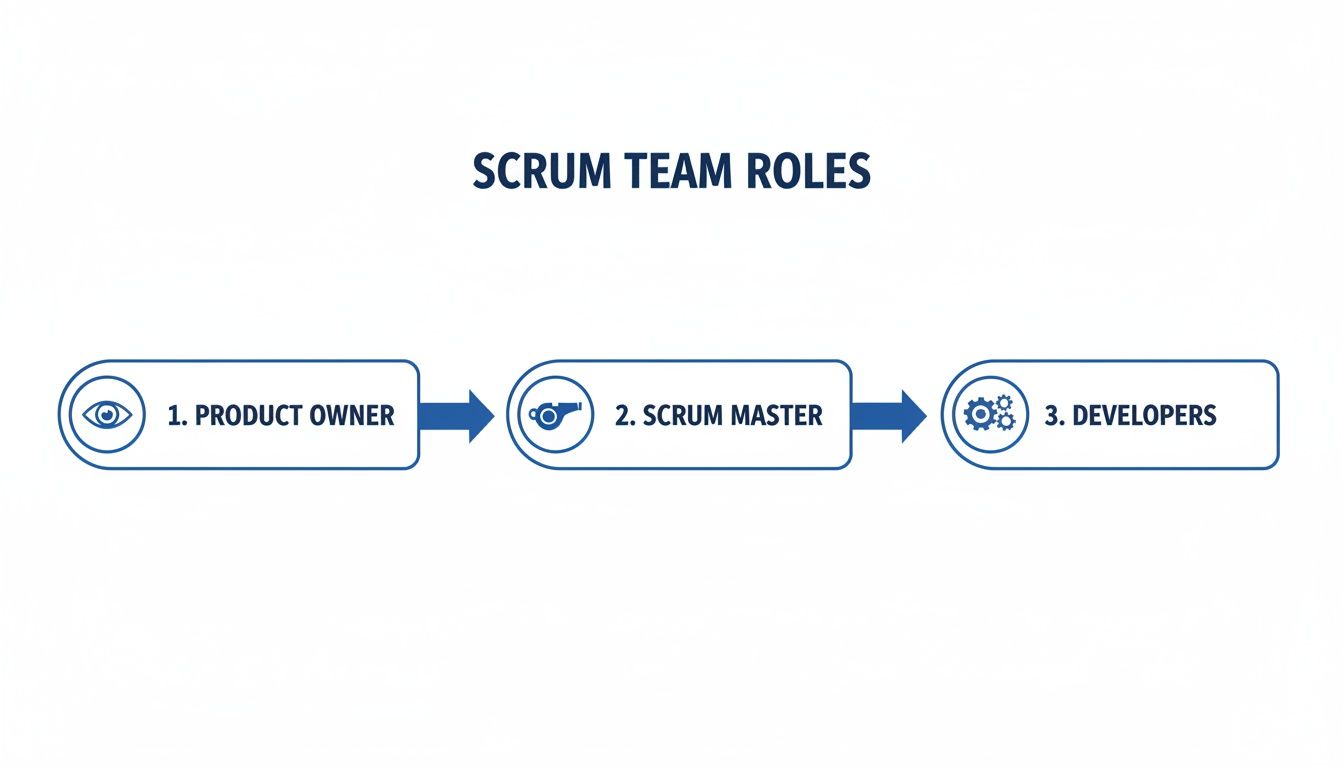
This visual really highlights how the Product Owner's vision, the Scrum Master's guidance, and the Developers' execution come together to create a valuable piece of the product. The Sprint Review is the key moment to gather feedback and adapt the Product Backlog for future Sprints, making sure the product evolves based on real user input.
The Sprint Retrospective: Improving the Process
The final event is the Sprint Retrospective, where the team inspects itself. This is a dedicated time to reflect on the past Sprint—what worked well with individuals, interactions, processes, and tools, and what could be improved.
The team then creates a plan for implementing those improvements in the next Sprint. This event is the engine of continuous improvement in Scrum, ensuring the team gets more effective and enjoys their work more over time.
To help tie this all together, here’s a quick breakdown of the four events that make up every Sprint.
The 4 Events of a Scrum Sprint
| Scrum Event | Purpose | Typical Duration | Key Participants |
|---|---|---|---|
| Sprint Planning | To plan the work for the upcoming Sprint. | 4 hours | The entire Scrum Team |
| Daily Scrum | To inspect progress and adapt the plan for the day. | 15 minutes | Developers (Scrum Master and Product Owner can attend) |
| Sprint Review | To showcase the work done and gather feedback. | 2 hours | The Scrum Team and key stakeholders |
| Sprint Retrospective | To reflect on the Sprint and identify improvements. | 1.5 hours | The entire Scrum Team |
Each of these events has a specific purpose and timebox, creating a predictable framework that keeps the team focused and moving forward. By consistently following this rhythm, teams can build amazing products one Sprint at a time.
Scrum Artifacts: The Tools for Transparency
If Scrum events give the work its rhythm, then Scrum artifacts are the map. These three documents are all about making the work visible and tangible. They ensure everyone—from the Developers slinging code to the CEO in the corner office—is looking at the same picture of what's done, what's in progress, and what's next. Think of them as the physical tools that bring the core pillar of transparency to life.
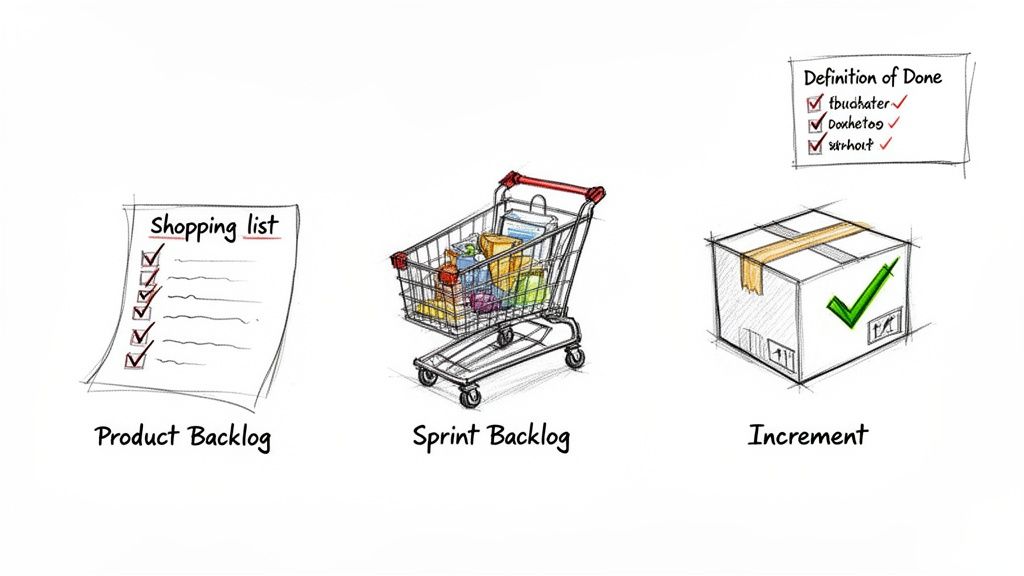
Let's stick with a simple analogy to make this crystal clear: imagine you're planning a massive dinner party. The artifacts are just different types of lists you'd use to pull it off.
The Product Backlog
First up is the Product Backlog. This is the master wish list for the entire product. It’s a single, prioritized list of everything that might ever be needed, from huge new features down to tiny bug fixes and performance tweaks. The Product Owner owns this document, constantly refining and reordering it to make sure the most valuable items are always sitting right at the top, ready to go.
In our dinner party world, the Product Backlog is your complete, sprawling recipe book. It has every ingredient for every dish you could ever dream of making. It’s long, it’s detailed, and it changes every time you discover a new recipe or get a request from a guest.
The Sprint Backlog
Next, we have the Sprint Backlog. This is the game plan for a single Sprint. It’s made up of two things: the specific Product Backlog items the team commits to delivering, and a plan for how they'll get it done. This backlog is owned and managed entirely by the Developers—it's their plan to meet the Sprint Goal.
Back to our dinner party: this is your shopping list for today's trip to the grocery store. You've picked out the specific ingredients from your master recipe book that you need to cook tonight's meal. It's a focused, actionable subset of the much bigger list.
The real power of these artifacts lies in how they force clear communication. It’s no accident that agile projects—where Scrum is used in 87% of cases—boast a 75% success rate. Compare that to the 56% success rate for traditional waterfall projects. That success is often tied directly to the clarity that artifacts provide. You can find more data on agile project success rates on Parabol.co.
The Increment and The Definition of Done
Finally, there's the Increment. This is the sum of all the Product Backlog items completed during a Sprint. Most importantly, it has to be in a usable, working condition that meets the team’s Definition of Done.
This Definition of Done is one of the most critical concepts in Scrum. It's a formal, shared agreement on what it means for work to be truly "complete." It’s a quality checklist that every piece of work must pass.
For example, it might include things like:
- Has all the code been commented and peer-reviewed?
- Have all automated tests passed?
- Is the user documentation updated to reflect the new changes?
This simple checklist eliminates guesswork and ensures every Increment is a high-quality, potentially shippable piece of the product. It’s how teams build amazing things, one solid, consistent Sprint at a time.
Putting Scrum Into Practice
Knowing the theory is one thing, but making Scrum actually work for your team means bringing its principles to life. The jump from concept to reality usually starts with a simple but surprisingly powerful tool: a digital task board. With a little setup, a basic board becomes a dynamic Scrum board, the true heart of your team's workflow.
This visual tool is what you'll use to manage the Sprint Backlog. Instead of relying on messy spreadsheets or static lists, you create columns like "To Do," "In Progress," and "Done." This simple layout delivers instant transparency—a core pillar of Scrum—letting anyone see the exact status of every piece of work at a glance.
Facilitating the Scrum Workflow
A well-organized board makes running Scrum events a whole lot smoother. During the Daily Scrum, team members can huddle around the board (whether in person or online) and physically move tasks to show what they've accomplished. Features like drag-and-drop updates ensure the board is always current, which is exactly what you need for those quick, effective sync-ups.
Come the Sprint Review, that "Done" column becomes your record of achievement. It gives stakeholders a crystal-clear picture of what the team delivered, making the entire review more engaging and grounded in real results.
By bringing all the work onto a shared board, you cut down on the chaos and stop forcing people to jump between different apps. It becomes the single source of truth that keeps everyone aligned and laser-focused on the Sprint Goal.
This is where tools designed to plug directly into your daily workflow really shine. For example, Tooling Studio's extensions for Google Workspace let teams build out a complete Scrum board right inside familiar places like Gmail or Google Tasks. It's a smart way to keep all your task assignments, comments, and collaboration in one place without adding another tool to the pile.
While Scrum offers a structured, time-boxed framework, it’s not the only agile game in town. It’s always a good idea to understand the alternatives to make sure you’re picking the best fit for your team. For instance, you can see how Kanban’s flow-based system stacks up by reading our guide on when to use Kanban vs Scrum. A quick comparison can help you make a much more informed decision.
Common Questions About Scrum Methodology
Even after you've got a handle on the roles, events, and artifacts, a few practical questions almost always pop up when teams start digging into what Scrum really is. Let's tackle some of the most common ones to clear up any lingering confusion and help you get started with confidence.
These questions usually get at the heart of how Scrum fits into the bigger picture of Agile, whether it can work outside of tech, and what the real-world timeline for getting up and running looks like. Nailing these answers can save you from some common bumps in the road.
What Is the Difference Between Scrum and Agile?
This is a big one. Think of Agile as the overall philosophy—a set of guiding principles for building products. It’s all about flexibility, putting the customer first, and being able to respond to change. You could say Agile is the "why" behind working this way.
Scrum, on the other hand, is a specific framework for putting that Agile philosophy into practice. It gives you the concrete roles, events, and artifacts—the "how"—to make it happen. So, while every Scrum team is agile by nature, not every agile team uses the Scrum framework.
Can Scrum Be Used for Non-Software Projects?
Absolutely. Scrum got its start in the software world, but its power lies in managing any kind of complex work. That’s why it has spread to so many other fields.
Today, you'll find it being used successfully by all sorts of teams:
- Marketing: For running campaigns, creating content, and planning events.
- Sales: To organize outreach sprints and track progress through the sales pipeline.
- Research: In academic or R&D labs to manage experiments and publish findings.
- Design: For iterative product design and user experience projects.
The truth is, any project that benefits from breaking down big goals into smaller pieces, getting frequent feedback, and adapting as you learn can use Scrum. Its core ideas aren't tied to any single industry.
The key takeaway is that Scrum is a framework for solving complex adaptive problems. The nature of the problem, not the industry, determines its suitability. It provides a structure for teams to learn and improve as they go.
How Long Does It Take to Implement Scrum?
You can get the basic mechanics up and running in just a few days. Seriously. A team can define its roles, set up its first Sprint Planning meeting, and kick things off almost immediately.
But truly mastering Scrum? That's a different story. Adopting the mindset and embedding its five core values into your team's culture takes time and consistent practice. This deeper level of adoption, where the team becomes truly self-managing and lives and breathes continuous improvement, often takes several months of focused effort and honest reflection in Sprint Retrospectives.
Ready to put Scrum into practice without adding yet another tool to your tech stack? Tooling Studio offers lightweight extensions that bring powerful Kanban and Scrum boards directly into your Google Workspace. Manage Sprints, assign tasks, and collaborate with your team right inside Gmail and Google Tasks. Explore Tooling Studio's solutions and centralize your workflow today.
 Download our Plugin