
Effective Communication Skills in the Workplace: Top Tips
Unlock your team's potential. Learn effective communication skills workplace strategies to boost productivity, foster collaboration, drive results.
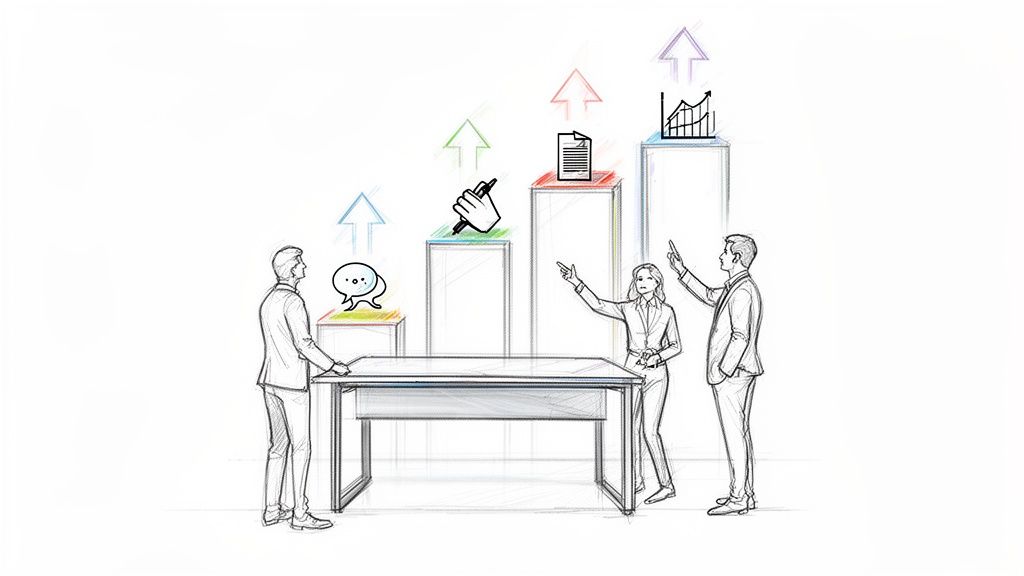
When we talk about effective communication skills in the workplace, we're not just talking about being a smooth talker or a fast typer. We're talking about the whole toolkit of abilities that lets people exchange information, build solid relationships, and actually get things done. This covers everything from writing a clear email and truly listening in a meeting to picking up on body language.
Ultimately, these skills are the bedrock of great teamwork, inspiring leadership, and happy customers.
The True Cost of Communication Breakdowns
Communication is the engine that powers your entire business. When that engine starts to sputter, the consequences are real, expensive, and they ripple out everywhere. Think of it like a faulty GPS on a cross-country road trip. A few bad directions don’t just cause a detour; they can leave you stranded in the middle of nowhere.
Small misunderstandings have a nasty habit of snowballing into massive operational failures. An ambiguous email leads to a blown deadline. A poorly explained task results in hours of wasted rework. Over time, these little hiccups eat away at project timelines, crush team morale, and chip away at client trust. It’s like a silent tax on your productivity and profits.
The Financial and Career Consequences
The fallout from poor communication isn't just a theory; it shows up in cold, hard numbers and stalled careers. Research has found that a staggering 68% of people have stopped doing business with a company simply because of a bad communication experience. That hits customer retention and revenue right where it hurts, proving that how your team talks internally directly shapes how the outside world sees you.
Inside the company, the costs are just as steep. The same study revealed that 41% of employees felt that unclear directions from their boss held them back from doing their job properly. Even worse, 18% said poor communication was the direct reason they missed out on a promotion or another career opportunity. There's a straight line connecting communication breakdowns to failed projects and stunted professional growth. You can get the full story by reading the research on communication statistics.
Ineffective communication is the friction that slows a high-performance team to a crawl. It creates drag on every project, burns through valuable resources, and turns clear goals into a frustrating mess.
The Domino Effect on Team Performance
When communication breaks down, the first domino to fall is clarity. No one is quite sure what they're supposed to be doing. That lack of clarity quickly topples the next domino: trust. Team members start getting hesitant. They stop asking questions because they don't want to look like they aren't paying attention, or they quietly stop relying on colleagues who are consistently vague.
This is where the third domino - **disengagement -**comes crashing down. When people feel like they aren't being heard or are constantly misunderstood, they start to check out. Their motivation dips, and their commitment to the team's goals starts to fade.
Finally, the last and biggest domino falls: project failure. The combined weight of all the delays, errors, and a checked-out team becomes too much to bear. What started as a promising project ends up as a costly lesson on why mastering effective communication skills in the workplace is so incredibly important.
The Four Pillars of Workplace Communication
If you want to get good at workplace communication, you have to think beyond just "talking more." Truly effective communication is like a well-built table, it stands firmly on four legs. If one leg is wobbly, the whole thing becomes unstable. These four pillars are Verbal, Non-Verbal, Written, and Visual communication.
Each one has its own job to do, and getting strong in all four gives you a powerful, complete toolkit. It's easy to fall into the trap of thinking you're a great communicator just because you excel in one area, but that's where wires get crossed. A brilliantly written email (Written) can be completely undone by dismissive body language (Non-Verbal) in a follow-up meeting.
Verbal Communication: The Art of Speaking with Intent
When people hear "communication," this is usually what comes to mind—the spoken word. It’s the daily stand-ups, the one-on-one check-ins, the big client calls, and those spontaneous chats by the coffee machine. But its power isn't just in the words you pick; it’s all about clarity, tone, and active listening.
Think about the last project kickoff you were in. Poor verbal communication is when the leader rambles through the goals without a clear agenda, leaving everyone nodding along but secretly confused about what to do next.
On the flip side, effective verbal communication is crisp and intentional. It means starting a meeting with a clear purpose, laying out milestones with precision, and genuinely listening to questions. It’s the simple act of paraphrasing what you hear - "Okay, so just to confirm, you're saying the mockups are due next Friday?"—to make sure everyone is on the same page. This small habit prevents tiny misunderstandings from snowballing into massive problems.
Non-Verbal Communication: What You Say Without Speaking
Non-verbal communication is the silent partner to everything you say out loud. It's your body language, your facial expressions, your eye contact, and even your posture on a video call. This pillar is incredibly potent because it often broadcasts our true feelings, and it can build or break trust in a heartbeat. In fact, a classic UCLA study found that up to 93% of communication effectiveness comes down to non-verbal cues.
Picture a hybrid team meeting. A manager says, "I'm totally open to your feedback," but they're also checking their phone and avoiding eye contact. The message is completely mixed. Their non-verbal signals are screaming louder than their words, effectively shutting down the conversation and making the team feel ignored.
True engagement is demonstrated, not just declared. Your posture, eye contact, and attentiveness on a video call communicate respect far more effectively than words alone.
Getting better at this just means being present. It’s nodding to show you’re tracking, maintaining an open and relaxed posture, and making intentional eye contact. In a remote world, it’s looking at the camera instead of just your screen to forge a real connection.
Written Communication: Crafting Clarity and Action
In any modern workplace, written communication is the engine that keeps things running. We’re talking emails, updates in shared docs, Slack messages, and formal reports. The name of the game here is to be clear, concise, and actionable. Bad written communication creates ambiguity, forcing people to waste time trying to figure out what you mean.
A poorly written project update is often a single, dense paragraph with no obvious next step. Team members read it and are left thinking, "So... what am I supposed to do with this?"
An effective written message, however, is designed to be easily digested. It might use:
A sharp subject line that says exactly what's inside.
Bulleted lists to break down key points.
Bold text for deadlines or critical details.
A clear "Next Steps" section with names assigned.
This kind of writing respects the reader's time and makes sure every message pushes the project forward, instead of creating more questions.
Visual Communication: Showing What You Mean
The final pillar, visual communication, is all about getting ideas across with graphics, charts, and shared dashboards. We're all drowning in information, and sometimes a simple visual can cut through the noise better than a thousand words. A Kanban board, for example, gives you an instant, at-a-glance status report for an entire project.
Instead of chasing down updates through a dozen emails, a shared visual tool tells the story immediately. For teams looking to weave this into their workflow, it's worth exploring the benefits of unified communication platforms, which show how bringing these tools together in one place boosts clarity and keeps everyone aligned.
At a high level, mastering these four pillars is not just a "nice-to-have." Poor communication wastes time, frays client relationships, blows up project timelines, and can even stall your career.
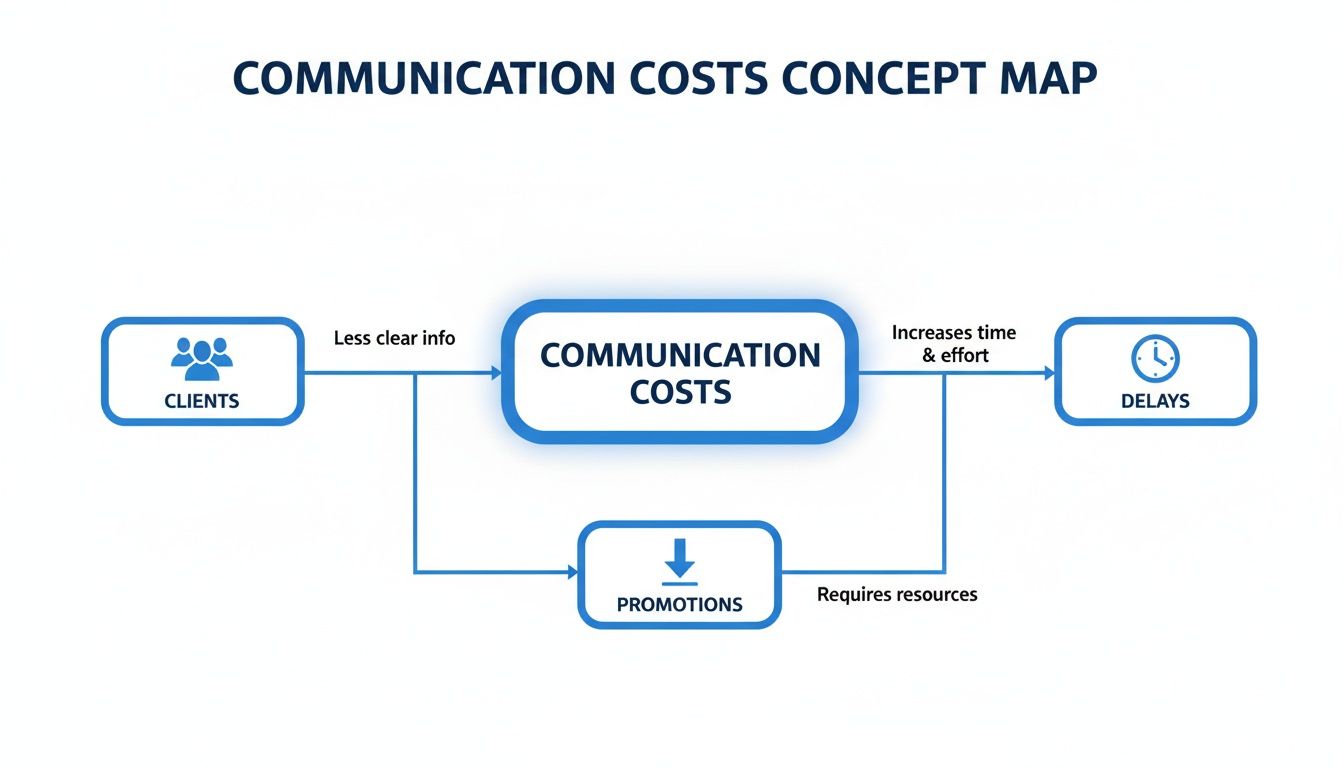
As this graphic shows, communication breakdowns have real costs, from losing clients to missing out on that next promotion. By strengthening all four pillars, you build a resilient communication style that empowers your team and drives real results.
To make these concepts even clearer, here’s a quick summary of how the four pillars work together.
The Four Communication Pillars at a Glance
| Pillar | Primary Channel | Key Improvement Tip |
|---|---|---|
| Verbal | Meetings, Calls, One-on-Ones | Practice active listening by paraphrasing what you hear to confirm understanding. |
| Non-Verbal | Body Language, Eye Contact | On video calls, look directly at the camera to create a stronger sense of connection. |
| Written | Emails, Reports, Instant Messages | Always include a clear call to action or "Next Steps" section to drive progress. |
| Visual | Charts, Dashboards, Diagrams | Use shared visual tools like Kanban boards to provide instant project status updates. |
Thinking of communication through this four-pillar framework helps you spot your weak points and intentionally work on them, making you a far more effective and well-rounded communicator.
Why Modern Work Requires a Communication Upgrade
Let's be honest, the way we work has been completely turned on its head, and our old communication habits just aren't cutting it anymore. Think back to the traditional office. It had a built-in information pipeline: those spontaneous desk-side chats, the quick questions you could ask in the hallway.
Those little, informal check-ins were the secret ingredient that kept projects moving. They solved minor issues before they could ever blow up into major problems.
Now, in our digital-first, hybrid world, that pipeline is gone. In its place, we often have a chaotic mess of endless email threads, a constant stream of chat notifications, and a calendar that looks like a game of Tetris with back-to-back video calls. This isn't just a poor substitute; it’s a recipe for burnout and information overload, leaving teams feeling more scattered than ever.
The Rise of Digital and the Decline of Connection
The shift has been dramatic. Face-to-face interaction, once the default, now makes up only 38.27% of communication for the average employee. Email is still a heavyweight, with 36% of organizations calling it their main channel. But here's the kicker: despite all this digital chatter, a whopping 44% of employees say that flexible work has actually damaged their sense of connection with colleagues.
This reveals a huge disconnect. We have more tools to talk to each other than at any point in history, yet misunderstanding and isolation are growing. The problem isn’t a lack of tools; it’s a lack of a real strategy.
The modern workplace doesn't need more communication channels; it needs more clarity. The challenge is to replace the volume of messages with the quality of a shared understanding.
For any team, especially those plugged into an ecosystem like Google Workspace, this new reality demands a more thoughtful approach. Just throwing another chat app into the mix won't solve anything. It's about building intentional communication habits that stop information silos before they even start.
Bridging the Gap with an Intentional Strategy
Without a deliberate plan, digital communication devolves into pure chaos. Important decisions get lost in rambling email chains. Critical updates disappear into the noise of a busy chat channel. This forces everyone to become digital detectives, wasting precious time hunting down information that should have been easy to find.
This is where your choice of tools and the habits you build around them, can make or break your team's success. Committing to a single source of truth isn't just a nice-to-have; it's essential.
Here’s what a smarter, more intentional strategy looks like in practice:
Centralize Task Management: Stop discussing tasks in one app and tracking them in another. Integrated tools, like a Kanban board that lives right inside your Gmail, keep the conversation and the workflow in the same place. No more confusion.
Give Every Channel a Job: Be crystal clear about what each tool is for. Maybe chat is for quick, informal questions, while email is reserved for formal announcements or decisions that need a clear paper trail.
Prioritize Asynchronous Communication: Cut back on the knee-jerk reaction to schedule yet another meeting. A well-written project brief or a clear task assignment in a shared space allows people to contribute on their own time, protecting everyone's ability to focus.
Adopting these habits helps turn technology from a constant distraction into a powerful ally. The challenge of keeping everyone on the same page gets a lot easier when you have a predictable system. For leaders navigating this shift, check out our guide on how to manage remote teams effectively.
And if you're interested in how AI is starting to streamline these interactions even further, you might want to explore supportGPT. Mastering effective communication skills workplace wide is no longer just about what you say, but about creating a system where crucial information simply can't get lost.
Actionable Strategies for Clearer Team Communication
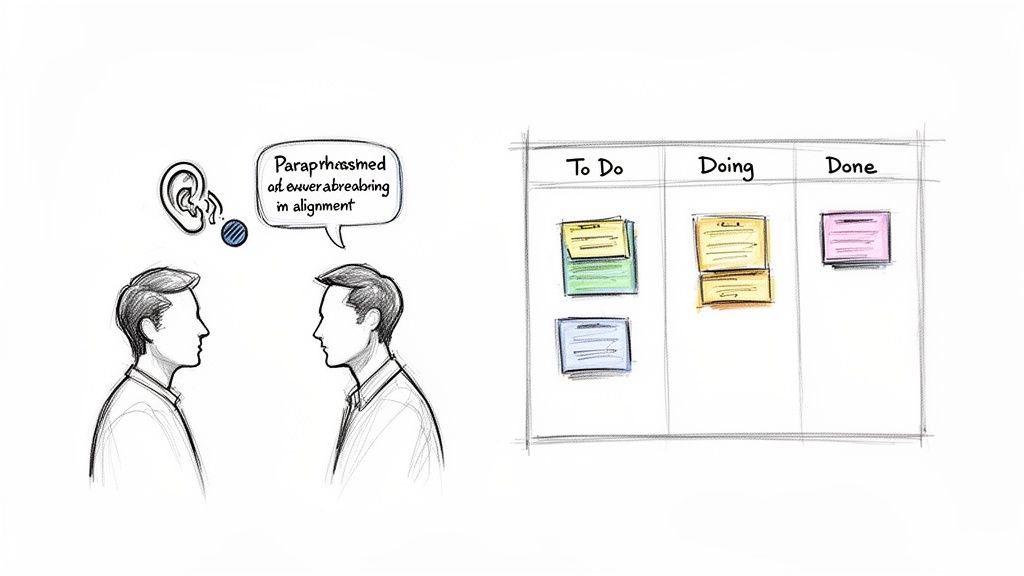
Knowing the theory behind great communication is one thing. Actually putting it into practice is a whole different ballgame, and it’s where real progress happens. This means shifting from ideas to actions with practical strategies you can start using today.
These aren't abstract concepts. They're tangible techniques designed to cut through ambiguity, build trust, and ultimately drive better results. We'll zero in on two of the most powerful areas: mastering active listening and delivering feedback that builds people up.
Become an Active Listener
Let's be honest: most of us listen with the intent to reply, not to truly understand. Active listening completely flips that script. It’s the disciplined practice of concentrating on what's being said, absorbing the meaning behind the words, and responding thoughtfully. Think of it less like a tennis match where you're just waiting to hit the ball back, and more like being a detective gathering clues to see the full picture.
The simplest yet most effective active listening technique is paraphrasing. After a colleague explains a complex issue, fight the urge to jump in with your solution. Instead, try saying something like:
"So, if I'm hearing you correctly, the main roadblock is..."
"Let me make sure I've got this right. You're saying that..."
"It sounds like your biggest concern is..."
This simple act does two crucial things. First, it forces you to actually process what was said. Second, it gives the other person a chance to confirm or correct your understanding, stopping misunderstandings dead in their tracks. A big part of this is also asking better questions for clearer communication.
Provide Feedback That Builds People Up
Feedback is a gift, but only if it's delivered well. Vague or harsh criticism just creates defensiveness and kills motivation. A structured approach, on the other hand, ensures your feedback is specific, objective, and focused on future improvement.
One of the best frameworks for this is the SBI Model (Situation-Behavior-Impact). It's brilliant because it removes judgment and sticks to observable facts.
Situation: Describe the specific context. "During this morning's client call..."
Behavior: State the exact, observable action. "...when you presented the new data..."
Impact: Explain the effect the behavior had on you or the team. "...it clearly showed your expertise and gave the client a ton of confidence in our plan."
This structure works just as well for constructive feedback, turning a potentially difficult conversation into a productive one. It shifts the focus from personal criticism to professional growth—a key part of building a team that trusts each other. If you want to dig deeper, you can learn more about how to improve team collaboration in our detailed guide.
Avoiding Common Communication Pitfalls
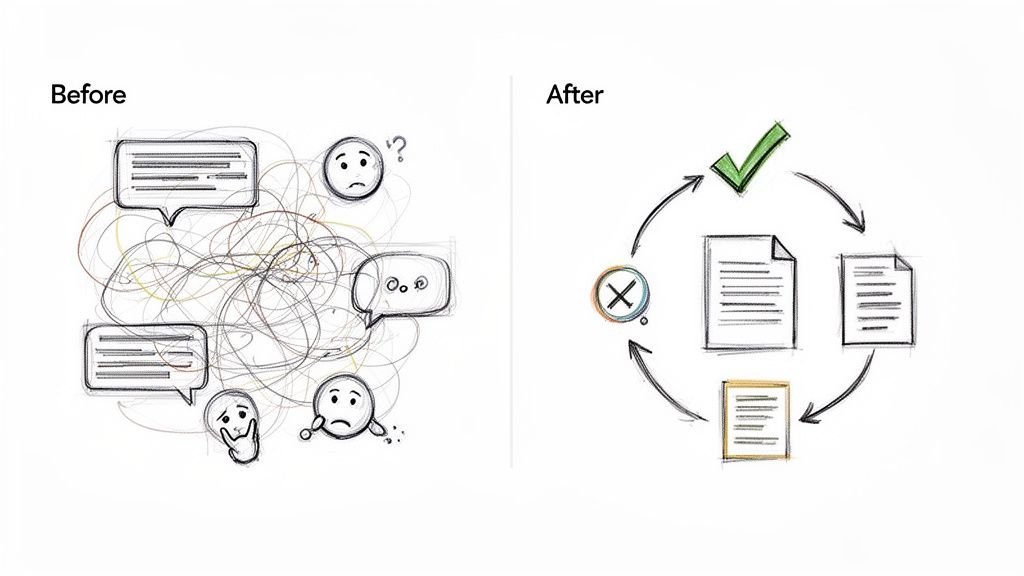
Even with the best intentions, communication can go sideways. The modern workplace is littered with subtle but powerful traps that breed confusion, stall projects, and slowly chip away at team morale. Learning to spot these pitfalls is the first real step toward building effective communication skills, workplace wide.
Think of these traps as potholes on the road to collaboration. If you don’t see them coming, you’re bound to hit one eventually, leading to a bumpy ride for the whole team. By learning to recognize and steer around them, you ensure a much smoother journey toward your goals.
The Curse of Knowledge
This is one of the sneakiest and most common traps out there. The "curse of knowledge" happens when you’re so deep in a subject that you completely forget what it’s like to not know it. You start making unconscious assumptions that everyone shares your context, causing you to gloss over critical details.
For instance, a project lead might slack the team, "Let's pivot the Q3 campaign based on the latest metrics." They know exactly which metrics and what the pivot entails. But a junior team member is left paralyzed, wondering if they should scrap their current work or just wait for more information that might never come.
Before: "Just update the deck with the new CRM data." (This assumes the other person knows which deck, where to find the data, and what "update" even means.)
After: "Could you please update the 'Client Kickoff Presentation' in our shared Google Drive? The latest sales figures from the CRM export I just dropped in the project channel need to be added to slide 7."
Leaving the Loop Open
Another classic misstep is failing to close the communication loop. This is what happens when a message goes out, but there’s no confirmation that it was received and understood. It creates a dangerous void where the sender assumes action is being taken, while the receiver might be totally confused or never even saw the message.
This is a huge problem in fast-paced digital environments. A quick "Got it, will have that done by EOD" isn't just a courtesy—it’s a vital part of the process. It confirms alignment and stops tasks from falling through the cracks. It turns a one-way shout into a two-way handshake.
Make it a habit to acknowledge important requests to avoid this:
Confirm Receipt: A simple "Received, thanks" or even a thumbs-up emoji can work for low-stakes messages.
Clarify Understanding: For anything more complex, paraphrase the request. "Just to confirm, you need me to pull the user engagement stats for the last 30 days. I'll get that over to you this afternoon."
Misinterpreting Digital Tone
Without facial expressions, body language, or tone of voice, digital messages are incredibly easy to get wrong. A short, direct message written for efficiency can easily come across as blunt or angry. A sarcastic joke meant to be lighthearted can land like a personal attack.
This is a massive challenge for remote and hybrid teams where text is the primary mode of communication. The lack of context forces our brains to fill in the blanks, and we often fill them with our own anxieties and worst-case assumptions, leading to completely unnecessary conflict.
Here’s how you can sidestep this pitfall:
Assume Positive Intent: When a message feels ambiguous, make your default assumption that the sender meant well. Give them the benefit of the doubt.
Use Emojis and GIFs Wisely: When it fits your company culture, a few well-placed visual cues can add the emotional context that text just can't provide.
Pick Up the Phone: If a chat is getting tense or you’re just going in circles, stop typing. A quick five-minute call will almost always resolve the issue faster than another dozen back-and-forth messages.
Got Questions About Workplace Communication?
Even when you have a solid game plan, putting new communication strategies into practice can feel a bit wobbly at first. Questions always pop up.
This final section tackles some of the most common hurdles leaders and teams run into when they start making these changes. Think of it as your quick-reference guide for navigating the real world of building better communication habits.
How Can I Encourage Better Communication Skills In My Team?
Honestly, the most powerful thing you can do is lead by example. If you want your team to communicate better, you have to model what "better" looks like, every single day. Practice active listening in every meeting. Send clear, written summaries after important calls. People notice, and they'll start to follow your lead.
Next, give everyone a consistent toolkit they can rely on. This doesn't have to be complicated—it could be a shared Kanban board right inside Gmail that becomes the single source of truth for who's doing what by when. This simple step cuts through so much of the noise and ambiguity.
Finally, you have to build psychological safety. You want to create an environment where anyone feels comfortable saying, "Hang on, I don't get it," or asking a clarifying question without feeling like they'll be judged for it. That's where real collaboration begins.
What Is The Most Important Communication Skill For A Manager?
While every skill we've talked about matters, if I had to pick just one for a manager, it’s the ability to set crystal-clear expectations. This is the bedrock of every successful project. It's about nailing down the "what," the "why," and the "when" for every single task and milestone.
Ambiguity is the silent killer of productivity. When people aren't sure what's expected, they hesitate, make assumptions, or do the wrong work. A visual tool like a shared Kanban board is fantastic for this because it puts everyone on the same page. There's no guessing about priorities or deadlines when it's all laid out for the team to see.
How Do I Address A Team Member With Poor Communication Habits?
When you need to have a tough conversation with someone about their communication, the formula is simple: be direct, do it in private, and get specific. Schedule a one-on-one and stick to the facts—observable behaviors and their impact, not broad personal judgments.
Instead of saying, "You're just not a great communicator," try something objective. "In yesterday's email about Project X, I was a bit unclear on the next steps. Could we walk through it together?" This opens the door for a productive conversation, not a defensive one.
From there, offer real support. Maybe you can suggest a simple template for project updates or show them how to use a collaborative tool more effectively. Always frame it around the team's shared goal of making the work smoother and more successful for everyone.
Ready to finally break down those communication silos and keep your team perfectly aligned? Tooling Studio brings powerful visual tools like Kanban Tasks, that brings kanban boards directly into your Gmail, creating one source of truth for all your projects. Stop the app-switching madness and start communicating with total clarity. Explore our solutions today.
 Download our Plugin